
Stablecoin flows are quietly reshaping market liquidity, shifting focus away from a simple price rebound.
Earlier, prolonged net outflows removed deployable capital, which weakened participation and capped upside. Now, flows have reversed, lifting total supply toward $315 billion, signaling capital returning on-chain as conditions stabilize.
This shift matters because stablecoins act as immediate buying power rather than passive value storage. AMBCrypto noted in a report earlier that Ethereum [ETH] holds about $163.5 billion in stablecoins, which keeps it central to settlement and liquidity routing.
As liquidity rebuilds, market structure begins to firm, since available capital supports bids and absorbs sell pressure. However, direction now depends on intent, because only active deployment in risk can sustain a broader upside move.
Liquidity reversal gains traction as stablecoin flows flip to inflows
Stablecoin netflows on Binance reveal how liquidity conditions are actively shifting beneath price action.
Earlier, flows sank by over $6.7 billion in mid-February, as ETF outflows above $1 billion and derivatives stress pushed capital off exchanges. This withdrawal reduced immediate buying power, which explains why the price struggled to sustain upside.
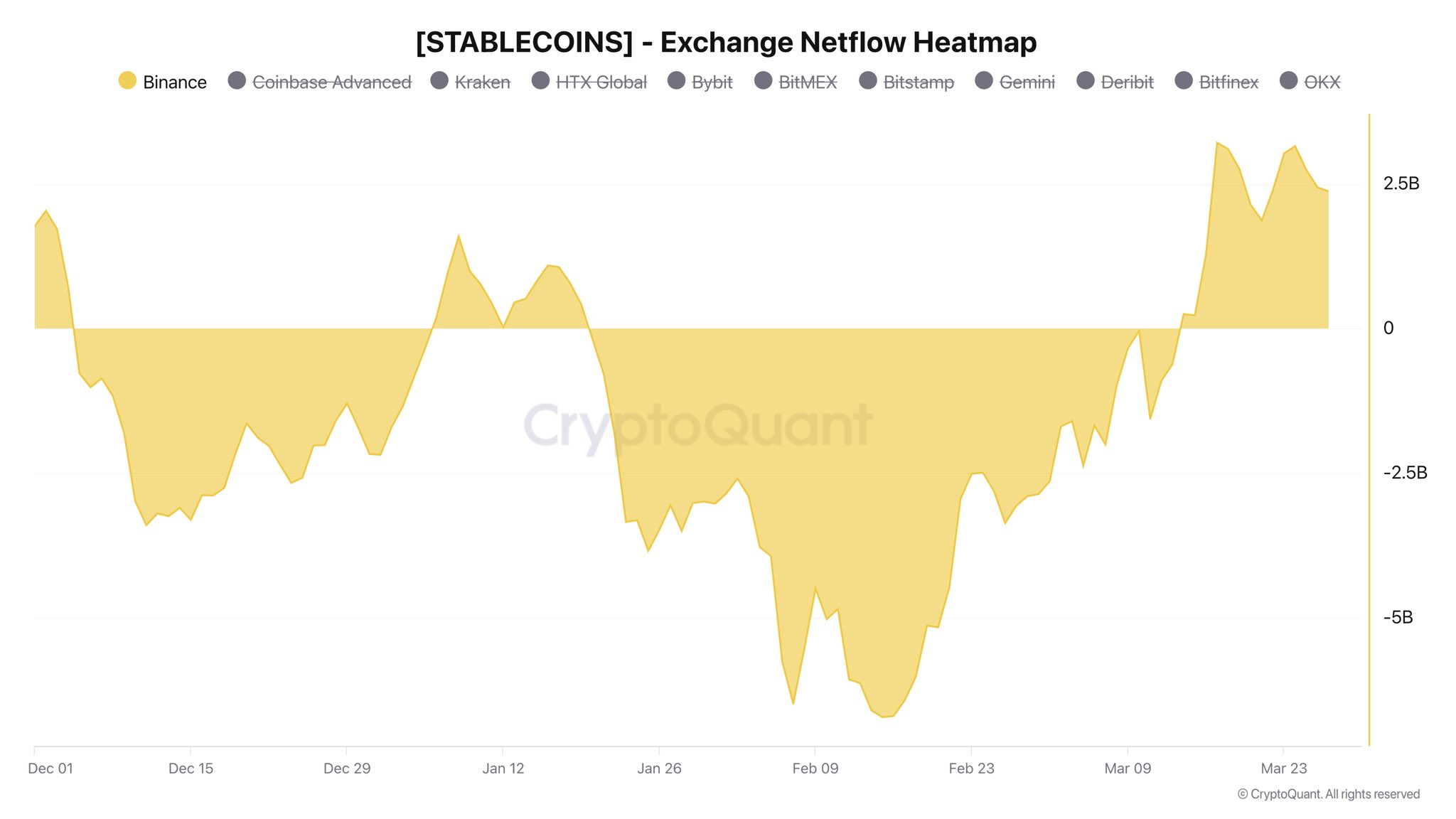
As selling pressure eased, outflows began to narrow, showing that defensive positioning was losing strength. This shift then accelerated, flipping into over $2.4 billion of inflow by late March, which signals capital returning with intent rather than hesitation.
As a result, stablecoins now rebuild exchange liquidity, restoring the dry powder needed for accumulation and rotation into risk assets.
This shift tightens market structure, yet direction now hinges on deployment, since only active risk allocation can turn liquidity into sustained upside.
Liquidity returns, but weak deployment caps conviction
Ethereum still anchors crypto liquidity, yet that liquidity shows hesitation rather than conviction. Capital is returning on-chain for settlement, but DeFi TVL near $53.2 billion showed only a 0.58% monthly rise and a 2.91% weekly fall, signaling weak deployment.
This behavior explained the current price structure, as Bitcoin [BTC] traded near $67,400 within $65,000 to $72,000 support and $79,000 to $82,000 resistance. Ethereum hovered around $2,040–$2,050, reflecting cautious positioning rather than aggressive accumulation.
Moreover, macro pressure persisted, with DXY near 100 and yields above 4.39%, limiting risk appetite. Liquidity has returned, but only active deployment can convert this into sustained upside.
If stablecoin inflows persist and Ethereum channels liquidity into DeFi, BTC and ETH can build stronger support and sustain upside. However, if capital remains idle and macro pressure persists, this recovery risks fading into a short-lived, reflexive bounce.
Final Summary
- Stablecoin liquidity shifts from outflows to inflows, rebuilding market depth, yet sustained upside depends on active deployment into risk assets.
- Ethereum [ETH] anchors these flows, but weak DeFi usage and macro pressure keep capital cautious, risking a short-lived bounce.
Go to Source to See Full Article
Author: Muriuki Lazaro