
Another day, another attack.
This time it’s Vercel – a Web3 infrastructure provider that fell prey to an attack comprising a ‘limited subset’ of customers’ credentials. As per the bulletin presented by the Vercel team, an illicit actor got access to API keys of various Vercel customers, maneuvering the entire app.
Further investigation revealed that the hacker had mainly aimed at the Google Workspace OAuth app, initiated via Context.ai, a third-party AI tool. With this small tool, the attacker was able to impact multiple users of the OAuth app across various organizations, including Vercel.
Once getting access to the platform’s Google Workspace, the hacker was capable of manipulating unmarked “sensitive” environment variables.
However, after the attack, the team ensured:
Environment variables marked as “sensitive” in Vercel are stored in a manner that prevents them from being read, and we currently do not have evidence that those values were accessed.
Vercel’s CEO weighs in
All this hints at the fact that the security incident was not spontaneous but a smartly polished one. As expected, Vercel CEO Guillermo Rauch also echoed similar sentiments when he said,
We believe the attacking group to be highly sophisticated and, I strongly suspect, significantly accelerated by AI. They moved with surprising velocity and in-depth understanding of Vercel.
Guillermo added,
Unfortunately, the attacker got further access through their enumeration.
Therefore, to avoid further strain from the attack, Vercel advised its customers to review, rotate, investigate, and take advantage of “sensitive” environment variables.
Other revelations that shook the crypto community
Notably, in a plot twist, an X user shared a screenshot of how Vercel also struck a deal to sell their company’s internal database, starting from $500K BTC payments on BreachForum.

Though this move seems to be made by the supposed hacker as a ransom demand from Vercel.
This is because in another screenshot of a conversation between Vercel’s team and the hacker, the former requested the wrongdoer to discontinue contacting their employees.
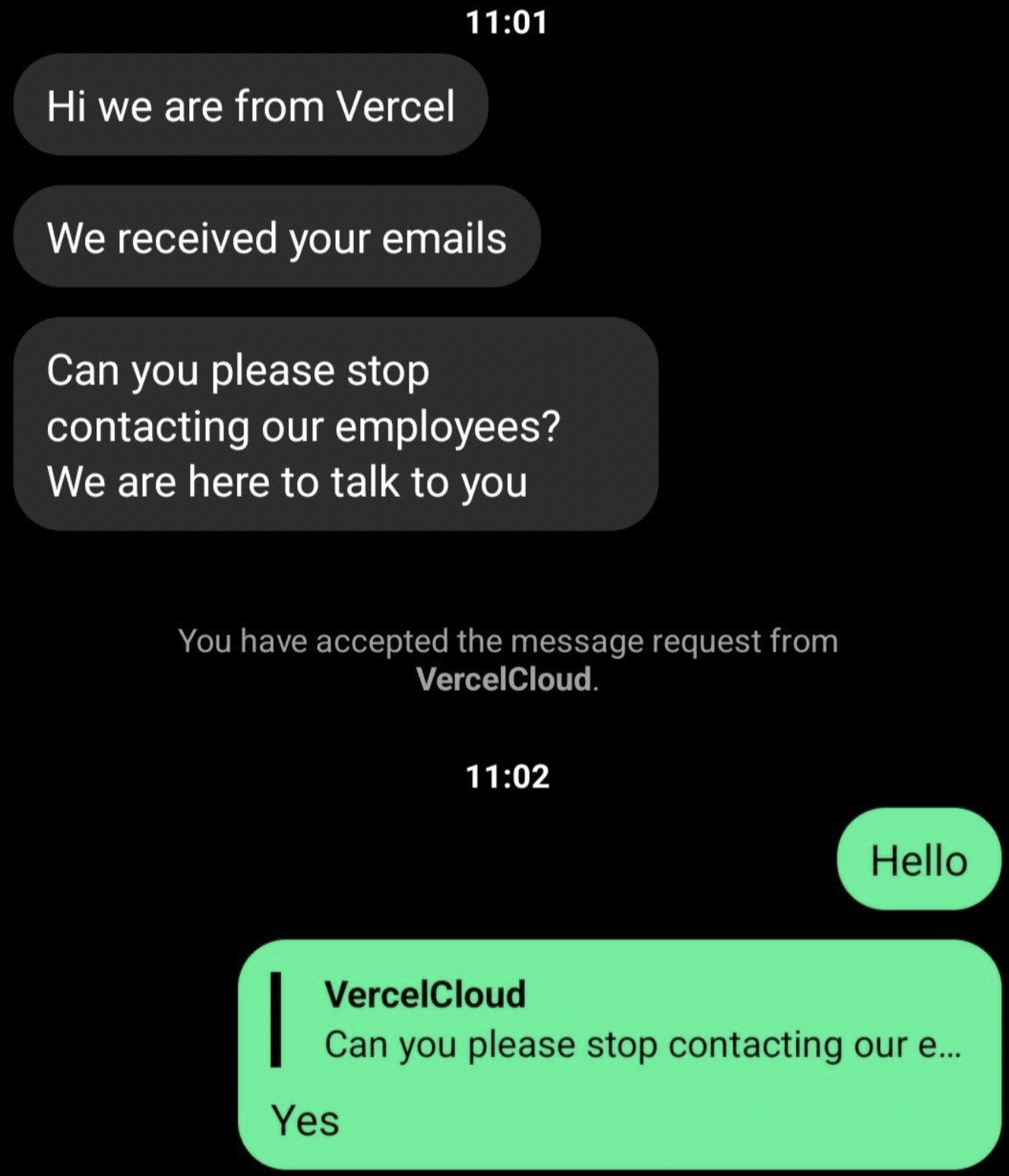
Needless to say, amidst ongoing FUD around the Vercel security incident, its supply chain also became a point of concern. The CEO, however, came forward to assure everyone and noted,
We’ve analyzed our supply chain, ensuring Next.js, Turbopack, and our many open source projects remain safe for our community.
Jupiter and Orca take precautionary steps
Additionally, despite being unaffected by the incident, the team at Jupiter took their safety measures.
We have reviewed all our logs, finding no suspicious activity, and have begun the process of rotating all our keys.
At the same time, since Orca’s (a Solana-based DEX) front end is hosted on Vercel, the team also took its steps and penned,
Out of precaution, we’ve rotated all secrets and deployment credentials that could have been exposed.
Additional attacks
This incident comes on the heels of a DPRK-linked actor attacking the device of one of Zerion’s team members, resulting in $100K lost in funds.
Moreover, just a day ago, $294 million was lost in the KelpDAO exploit that had hit over 20 chains and was identified as the biggest attack of 2026.
Final Summary
- The illicit actor aimed at the Google Workspace OAuth app, leading to Vercel customers’ getting compromised.
- Besides Vercel, platforms like Jupiter and Orca have also taken precautionary steps to avoid further damage.
Go to Source to See Full Article
Author: Ishika Kumari