Key Takeaway
Why did this wallet movement attract attention?
It’s rare for Satoshi-era wallets to reactivate, and such moves often raise speculation that early holders might be preparing to sell.
Could this wallet move cause a price drop?
Unlikely. Similar awakenings in 2021 and 2023 didn’t lead to major sell-offs, as they were later found to be internal reorganizations.
After more than 14 years of silence, a relic from Bitcoin’s earliest days has suddenly come back to life.
A Satoshi-era wallet, which mined 4,000 Bitcoin [BTC] between April and June 2009, just months after Bitcoin’s creation, has made its first move since 2011.
The long-dormant address transferred 150 BTC, reigniting curiosity among analysts and on-chain watchers.
Back when it was last active, those coins were worth barely $67,724.
At the time of writing, that same stash holds an astonishing value of $442 million, making this one of the most remarkable reawakenings in Bitcoin’s history.
This coincided with…
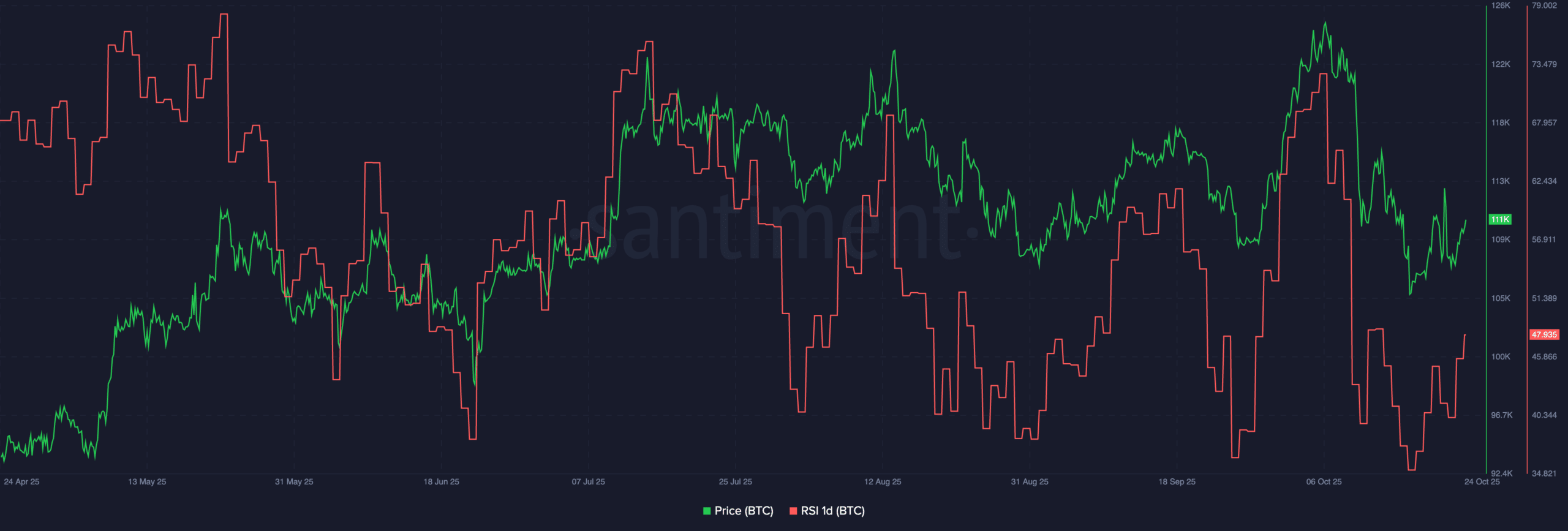
The timing of the wallet’s reactivation comes as Bitcoin was trading around $111,286.63, at press time, marking a 2.24% increase in the past 24 hours, according to data from CoinMarketCap.
Historically, such awakenings from early Bitcoin wallets have tended to unsettle traders, often sparking speculation that long-term holders may be preparing to sell.
This sentiment seems to be reflected in current market indicators.
For instance, Bitcoin’s RSI dipped below the neutral threshold, signaling bearish control, though a slight upward movement hints that bulls are attempting to regain momentum.