
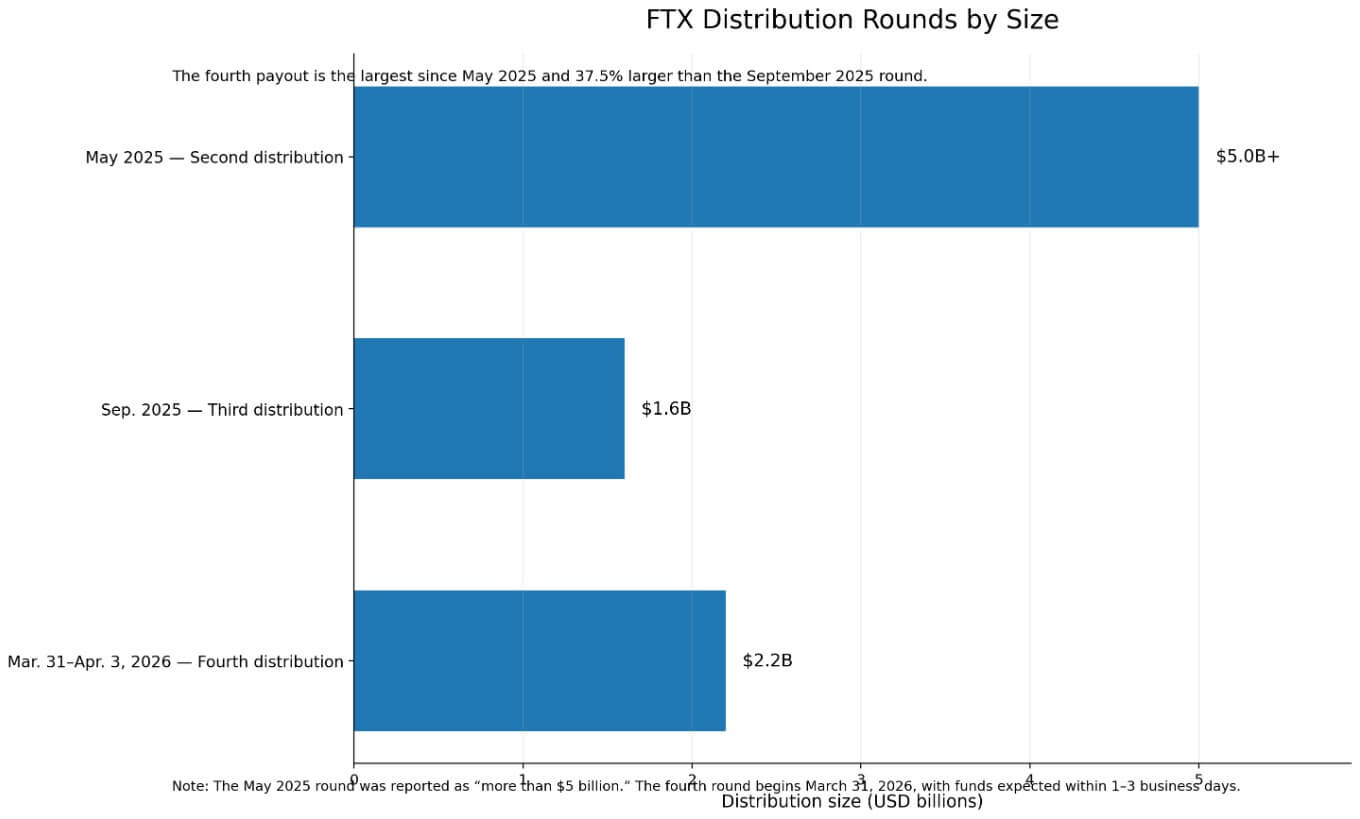
FTX’s fourth round of distributing bankruptcy recoveries arrives at a different moment. The estate will begin sending roughly $2.2 billion to eligible creditors on Mar. 31, just as Bitcoin (BTC) pushed back above $70,000 into what Glassnode called a thin $72,000-$82,000 on-chain zone.
FTX announced on Mar. 18 that its fourth distribution will begin Mar. 31 and end Apr. 3, with eligible creditors expected to receive funds via BitGo, Kraken, or Payoneer within 1 to 3 business days.
Dotcom customer claims receive an incremental 18% to reach 96% cumulative recovery, US customer claims receive 5% to reach 100%, and general unsecured and digital asset loan claims each receive 15% to reach 100%. Convenience claims stay at 120% cumulative.
This is the largest FTX distribution since the more than $5 billion second round in May 2025 and is 37.5% larger than the $1.6 billion third distribution in September 2025.
The nominal size alone makes it a real liquidity event, even though it falls short of half the scale of the May round.

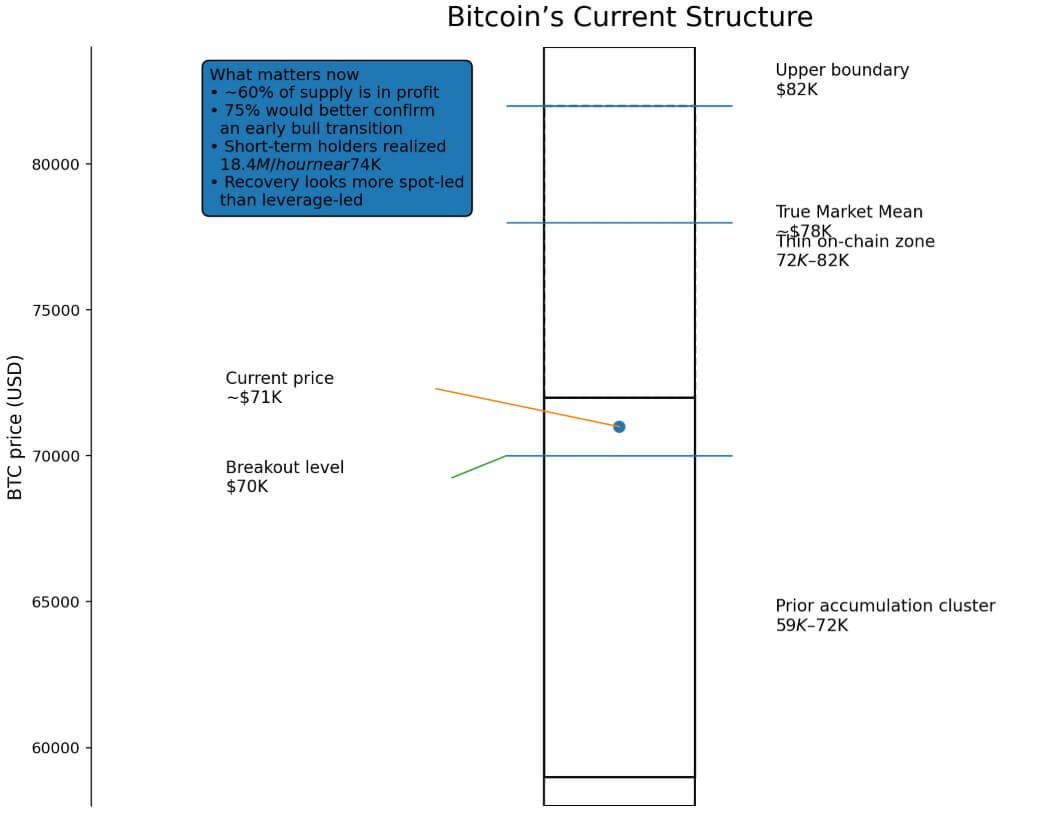
Bitcoin’s current structure
Bitcoin currently trades around $70,000 with an intraday low of $69,500, after yesterday’s high of $74,603
Glassnode’s Mar. 18 report said BTC had broken above $70,000 and entered a thinly accumulated $72,000 to $82,000 zone with limited on-chain resistance.
The market has probed into that zone but sits right on or just below the lower boundary, still working to hold the breakout cleanly.
Only about 60% of the supply is back in profit. Glassnode says a sustained move above 75% would be needed to confirm a genuine early bull transition.
The report still treated this as an early conviction rather than a fully validated bull regime.
As a result, the current setup is defined by absorption. Short-term holders realized profit spiked to $18.4 million per hour as BTC approached $74,000, echoing the same sell-into-strength behavior seen in February.
If the market can digest that selling and stay above $70,000, higher levels like the True Market Mean near $78,000 and the upper air-gap band near $82,000 become more plausible.
However, if absorption fails, the move still looks like a fragile bear market recovery rather than a durable trend change.
The current recovery looks more spot-led than leverage-led.
Glassnode says ETF allocations have rebounded, spot cumulative volume delta has turned higher, Coinbase spot activity has stabilized and turned positive, and CME futures positioning stays subdued.
CoinShares adds that digital asset investment products took in $1.06 billion last week, with Bitcoin accounting for $793 million, extending the three-week Bitcoin inflow run to $2.2 billion.
Derivatives present a constructive but restrained picture, as Glassnode sees the market emerging from negative funding and defensive hedging.
Deribit says BTC funding has moved back to roughly neutral, BTC futures-implied yields are flat at around 2% to 3% across tenors, and seven-day BTC implied volatility sits near 52%.
That profile fits a recovering market lacking aggressive speculative conviction.
Why FTX cash can have an impact now
CoinShares says Bitcoin investment products absorbed $2.2 billion over the last three weeks.
FTX is distributing $2.2 billion in cash. The two flows differ in nature: one represents direct Bitcoin fund inflows, while the other represents bankruptcy cash distributed to many creditors. Yet, their nominal size is identical.
The payout tests recycled liquidity, but it is unclear if even a small recycling ratio is enough to matter in a market trying to hold above $70,000 while absorbing $18.4 million per hour in short-term holder profit-taking.
Besides, Glassnode flagged that the FTX cash lands after the March options expiry tailwind. About $4.5 billion of negative dealer gamma sits around $75,000, with $3.9 billion expiring this month.
The report warns that once quarter-end expiry passes, the unwinding of dealer hedges could create headwinds or consolidation. FTX cash may hit just as a key supportive market mechanism fades.

A recycling model
At a 5% recycle rate, $110 million represents about 13.9% of last week’s Bitcoin fund inflows and roughly 6 hours at the current $18.4 million-per-hour short-term holder realized profit pace.
Important, though likely insufficient to drive direction alone.
At a 10% recycle rate, $220 million equals about 27.7% of last week’s Bitcoin fund inflows and about 12 hours of current short-term holder profit realization. Large enough to affect the price action over a short window, especially if ETF flows stay positive.
At a 20% recycle rate, $440 million represents about 55.5% of last week’s Bitcoin fund inflows and nearly 24 hours of current short-term holder profit realization. At that point, the payout becomes a meaningful marginal bid.
At a 30% recycle rate, $660 million equals about 83.2% of last week’s Bitcoin fund inflows. This is the level at which an FTX-driven re-risking wave would become visible relative to recent institutional spot demand.
If the full $2.2 billion were spread evenly over three days, that would be $733 million per business day.

Spread mechanically over 72 hours, it amounts to about $30.6 million per hour, versus the current $18.4 million per hour short-term holder realized profit rate. Even modest recycling rates become worth watching amid thin liquidity, where absorption capacity determines direction.
| Recycle rate | Cash potentially rotating back | Share of last week’s BTC fund inflows | Equivalent at $18.4M/hour STH profit-taking | Takeaway |
|---|---|---|---|---|
| 5% | $110M | 13.9% | ~6 hours | Noticeable, but likely not enough alone |
| 10% | $220M | 27.7% | ~12 hours | Can affect short-term price action |
| 20% | $440M | 55.5% | ~24 hours | Becomes a meaningful marginal bid |
| 30% | $660M | 83.2% | ~36 hours | Large enough to show up clearly in the tape |
The bull case assumes a 10% to 20% recycling rate, combined with positive ETF demand and a continued spot-led bid. BTC reclaims and holds the lower air-gap boundary, digests short-term holder selling, and starts trading toward the $78,000 True Market Mean, then $82,000.
The key tell would be price strength without a big re-leveraging in futures, validating the healthier spot-led recovery narrative.
The bear case assumes most recipients de-risk, hold cash, or redeploy elsewhere. BTC loses the lower air-gap boundary and drifts back toward the prior $64,000-$72,000 accumulation cluster.
The market effectively votes that returned FTX cash cannot overpower existing profit-taking and post-expiry headwinds.
The late-March window becomes a test of recycled liquidity landing in a spot-led market before leverage has fully returned.
What dictates the outcome is how much of the returned FTX money becomes fresh crypto demand.
Go to Source to See Full Article
Author: Gino Matos