The $5M FUNToken giveaway, live on 5m.fun, is a real-time study in how incentive design can influence market psychology. By rewarding holders who lock their tokens instead of trading them, the campaign is reshaping how participants think about value, time, and opportunity in the $FUN ecosystem.
The result is more than a tightening of circulating supply. It’s a behavioral shift. One where community members transition from passive holders to active, long-term participants in a shared economic experiment.
Turning traders into long-term participants
The structure of the $5M giveaway fundamentally changes how $FUN holders approach ownership. Instead of viewing the token as a short-term speculative asset, users are encouraged to stake and commit. Tokens locked into the verified Ethereum contract are temporarily removed from trading circulation, meaning that every staking action contributes to scarcity, while giving participants a tangible sense of ownership over future milestones.
At its core, this mechanism aligns economic behavior with psychological incentives. When holders see their staked $FUN working for them – accruing interest or qualifying for milestone-based unlocks – it reinforces patience over impulsivity. The act of staking becomes both a financial and emotional investment.
For many participants, the dashboard on 5m.fun isn’t just a data display; it’s a progress tracker that transforms passive observation into active anticipation. Watching price targets approach, seeing the global pool grow, and monitoring reward unlocks creates a sense of collective participation that trading alone doesn’t replicate.
The psychology of scarcity and commitment
Every staking event introduces a predictable economic effect: as more users stake, fewer tokens remain available in active circulation. But the psychological effect is even more powerful.
When holders know their tokens are locked and unavailable for quick sale, they tend to view those assets differently. They perceive it as long-term stakes in a shared venture rather than disposable inventory. This behavioral commitment reduces reactionary selling and strengthens price floors through collective restraint.
It’s the same principle that drives scarcity psychology in other asset classes: what’s locked feels valuable, and what’s scarce feels worth holding. The $FUN giveaway channels that sentiment into measurable market behavior.
Moreover, the contract’s structure magnifies this sense of alignment. As milestones approach, holders feel an increasing incentive to stay committed, not exit early. The anticipation of future unlocks replaces short-term trading motivation with the desire to “be there when it happens.”
Supply shock as a behavioral reinforcement
With more than 8.7 million $FUN already staked globally, the event has begun to produce a clear supply shock. A contraction in available tokens that reinforces confidence in the project’s structure. But the effect isn’t just numerical; it’s psychological.
The knowledge that a significant portion of the supply is locked builds a collective expectation of scarcity. In token markets, perception often precedes movement: when participants believe scarcity is rising, holding behavior strengthens further, creating a self-reinforcing cycle.
This is how giveaways like this move beyond mechanics and shape expectations. Every new stake becomes a visible statement of faith in the system, a signal that reinforces the belief that $FUN’s scarcity is real and valuable.
Trust through transparency
The credibility of this behavioral shift depends on transparency, and that’s where the audited Ethereum smart contract makes the biggest impact. Participants can see:
- The total amount of $FUN staked (updated live).
- The global progress toward price milestones (from $0.01 to $0.10 USDT).
- The leaderboard displays top stakers and estimated rewards.
This real-time visibility fosters a sense of shared trust. Everyone sees the same numbers. Everyone knows the same rules. There’s no hidden mechanism or centralized control. In psychological terms, this transparency reduces uncertainty – and with it, anxiety – allowing holders to remain calm and committed even through market fluctuations.
That clarity turns participation into confidence, and confidence into staying power, which are two of the strongest psychological foundations in any asset market.
A market in transition
According to CoinMarketCap, FUNToken ($FUN) is currently trading around $0.002667 USD, with a market capitalization of $28.86 million and a 24-hour trading volume of approximately $14.86 million.
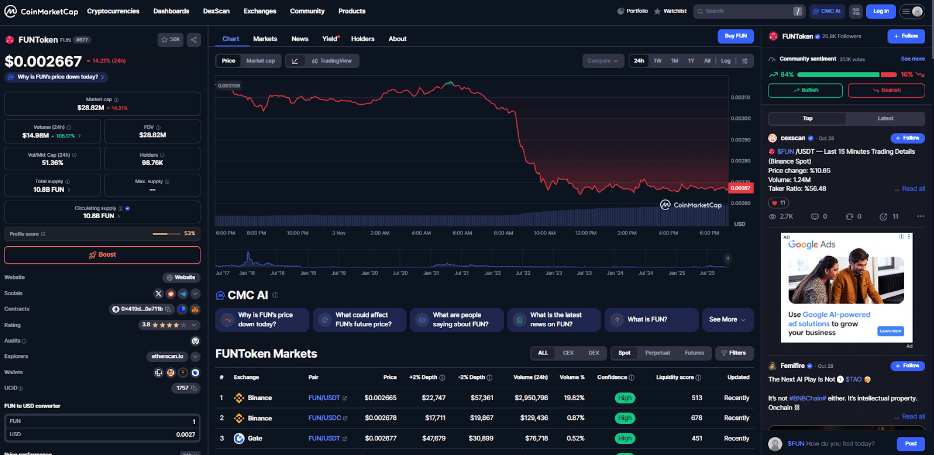
Recent market movements show consolidation near the $0.0026–$0.0027 range. While this phase may appear quiet, within the staking ecosystem, it reflects stability. The kind of patience-driven holding behavior the campaign was designed to encourage.
Every staker who joins reinforces the same dynamic: less supply in motion, more conviction in position.
Beyond economics: The social ripple effect
What’s happening with FUNToken right now is as much a community phenomenon as it is a financial one. Across the FUNToken Telegram group, discussions around milestones, leaderboard rankings, and staking outcomes have become a central point of engagement.
This constant interaction strengthens collective identity. When participants see others staking, earning, and holding, it normalizes commitment as the default behavior. The more visible this becomes, the stronger the psychological pressure toward participation, a pattern that has historically driven many successful community-led crypto movements.
Conclusion
The $5M FUNToken giveaway has achieved something rare: it has turned token economics into a behavioral engine. Through staking, transparent smart contracts, and milestone-based rewards, it’s not only tightening supply but reshaping how holders think and act.
By aligning incentives with patience and visibility, the campaign fosters a culture of confidence and restraint. All of which are qualities that often determine long-term success in volatile markets.
In the end, the most significant outcome of this supply shock might not just be reduced circulation, but the transformation of $FUN holders into a community that sees value not in selling, but in staying.
Disclaimer: The price mentioned was accurate at the time of writing (November 3, 2025) and may have changed since.
Disclaimer. Readers are encouraged to do their own research. Ambcrypto is not liable for any outcomes related to the use of information, products, or services mentioned. This content may include affiliate or partner links.
Go to Source to See Full Article
Author: AMBCrypto Team