The United States’ stablecoins plan continues to draw mixed views from analysts. The sector has grown by over $50 billion and surpassed $300 billion in total market supply following the passage of the GENIUS Act in July.
However, the White House’s $2-$4 trillion target by 2028-2030 and the primary goal of bolstering demand for U.S short-term Treasury bills may be too ambitious, according to some analysts.
According to Teresa Ho, Head of U.S short-duration strategy at JPMorgan, the post-GENIUS Act momentum for stablecoins has been positive. However, she added,
“But the speed at which it’s going to grow — I don’t think it’s going to grow to $2, $3, $4 trillion in just a couple years of time.”
For JPMorgan, the market could only grow to $700 billion over the next few years. Especially since interest-paying stablecoins are currently banned by law.
Stablecoin growth vs T-bill demand
Supporters of the stablecoin believe that it could become a staple in payments. Since they are mostly backed by short-term U.S Treasury bonds, it could also help service the fiscal debt in the long run.
According to S&P Global, the top U.S dollar-based stablecoin issuers (Tether and Circle) held about $155 billion worth of T-bills as of October 2025.
This translated to 2.5% of total U.S. T-bills, and was close to the 6.8% held by foreign officials. However, both were still below the 33% market share controlled by U.S money market funds.
The firm estimated that by the end of the year, the issuers could buy $50-$55 billion additional T-bills, adding that,
“If expectations of a two trillion-dollar USD stablecoin market in three years are met, participants will be key marginal buyers of short-term Treasuries.”
It linked the projected growth to regulated issuers, especially Tether, which debuted a compliant on-shore stablecoin called USAT.
In fact, as of July, Tether reported holding $127 billion worth of U.S. Treasury bills, making it the 17th largest U.S debt holder.
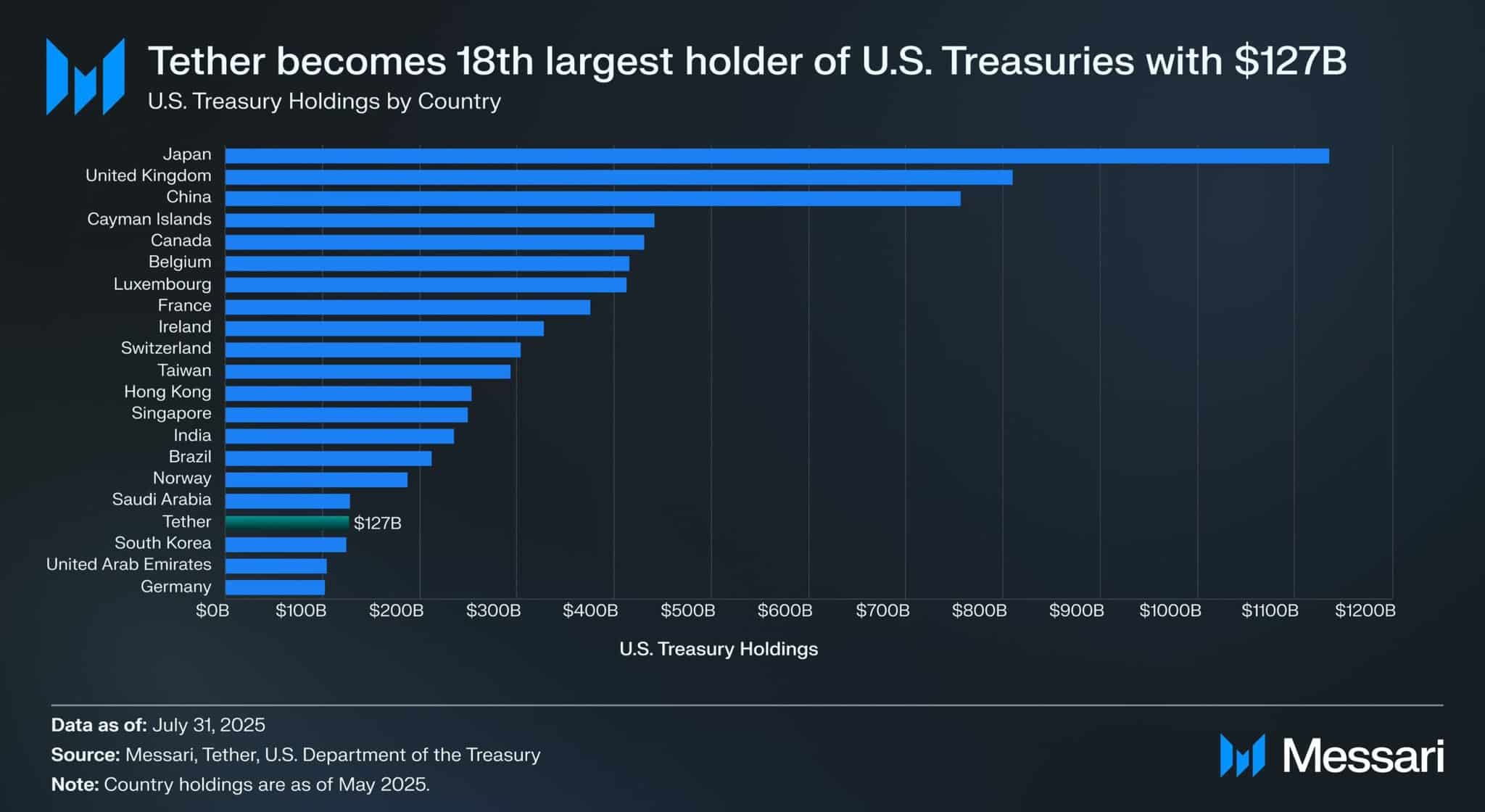
Source: Messari
China’s pushback
However, the current T-bill demand from stablecoin issuers is not only tiny compared to money market funds, but also to the overall U.S. fiscal debt, with the same hitting $38 trillion.
This may be the “real concern,” noted Steven Barrow, Head of G10 strategy at London-based Standard Bank. He added,
“It’s wrong to say stablecoins can’t solve anything, but it won’t get you out of that hole” of yawning debt and deficits, and “that’s where the real concern lies.”
Additionally, some countries, such as China, are cracking down on dollar-based stablecoins (USDT, USDC) to protect their financial stability.
Standard Chartered has also estimated that $1 trillion in capital outflows from emerging markets to stablecoins could happen by 2028, further highlighting the risks that could attract bans from these jurisdictions.
Final Thoughts
- The GENIUS Act has sparked growth, and stablecoin issuers could become ‘marginal’ T-bill buyers.
- However, critics argue that U.S-dollar-backed stablecoins are driving limited demand for T-bills and may face bans in countries such as China.
Go to Source to See Full Article
Author: Benjamin Njiri