Top Stories of The Week
Google Threat Intel flags ‘Ghostblade’ crypto-stealing malware
Google Threat Intelligence has identified a new form of crypto-stealing malware called “Ghostblade” that affects Apple iOS devices and is part of the “DarkSword” suite of browser-based malware tools designed to steal private keys and other sensitive information.
Ghostblade is written in JavaScript and designed for rapid data theft. The crypto-stealing malware activates, grabs sensitive data from the compromised device, and relays it to malicious servers, according to Google Threat Intelligence.
The Ghostblade malware does not run 24/7 on the compromised device, does not require extra plug-ins to function, and stops functioning after extracting data, making it more difficult to detect, the threat researchers said.
Quantum risk real, but not all crypto wallets equally vulnerable: Galaxy
The quantum risk to Bitcoin investors is real, but not all wallets are vulnerable, and the people best positioned to address it are working on it, says Galaxy Digital research analyst Will Owens.
Owens said in a report on Thursday that, in theory, a quantum computer could derive private keys from public keys, allowing an attacker to impersonate the owner, forge a signature and steal coins.
However, he argued that not all wallets are equally vulnerable to this risk.
“In fact, most wallets are not vulnerable today. Funds are at risk only when public keys are exposed on-chain,” he said.
Owens said that created two main ways wallets are exposed: those whose public keys are already visible, and wallets whose public keys are revealed at the time of spending.
Rumors emerge of a CLARITY Act deal between White House and lawmakers
Rumors are circulating that a tentative deal has been struck between the White House and US lawmakers on stablecoin yield, potentially moving the CLARITY crypto market structure bill forward.
Republican Senator Thom Tillis and Democratic Senator Angela Alsobrooks, both members of the Senate Committee on Banking, Housing, and Urban Affairs, have reached an “agreement in principle,” according to a Friday Politico report.
“I think what it will do is to allow us to protect innovation, but also gives us the opportunity to prevent widespread deposit flight,” Alsobrooks said, adding that the deal prohibits stablecoin yield on “passive balances.”

FBI warns fake FBI token on Tron is trying to scam users
The US Federal Bureau of Investigation says a scam using a token on the Tron blockchain is impersonating the agency with the aim of grabbing personal information.
FBI New York’s X account shared on Thursday a message some Tron users received via a token bearing the agency’s name and seal that said their wallet was “under investigation.”
The message then prompts the recipient to complete a sham anti-money laundering verification online “to avoid a total block on your assets.”
SEC interpretation on crypto laws ‘a beginning, not an end,’ says Atkins
US Securities and Exchange Commission (SEC) Chair Paul Atkins has clarified how the agency intends to approach digital asset regulation following an interpretative notice issued this week.
In prepared remarks for a Thursday speech at the Practising Law Institute, Atkins said that the SEC would take a different approach to digital assets than its previous “regulation by enforcement” campaign. According to the SEC chair, the agency would first focus on its interpretation of how federal securities laws apply to crypto following the signing of a memorandum of understanding with the Commodity Futures Trading Commission (CFTC) last week.
“[…] While the interpretation provides long-needed clarity, I should like to assure this audience that it amounts to a beginning, not an end,” said Atkins.
Most Memorable Quotations
“[…] While the interpretation provides long-needed clarity, I should like to assure this audience that it amounts to a beginning, not an end.”
Paul Atkins, US Securities and Exchange Commission (SEC) Chair
“A sustained push above 75% would carry considerably more weight as a confirmation of early bull market conditions, whereas continued rejection near current levels would reinforce the bear market recovery narrative.”
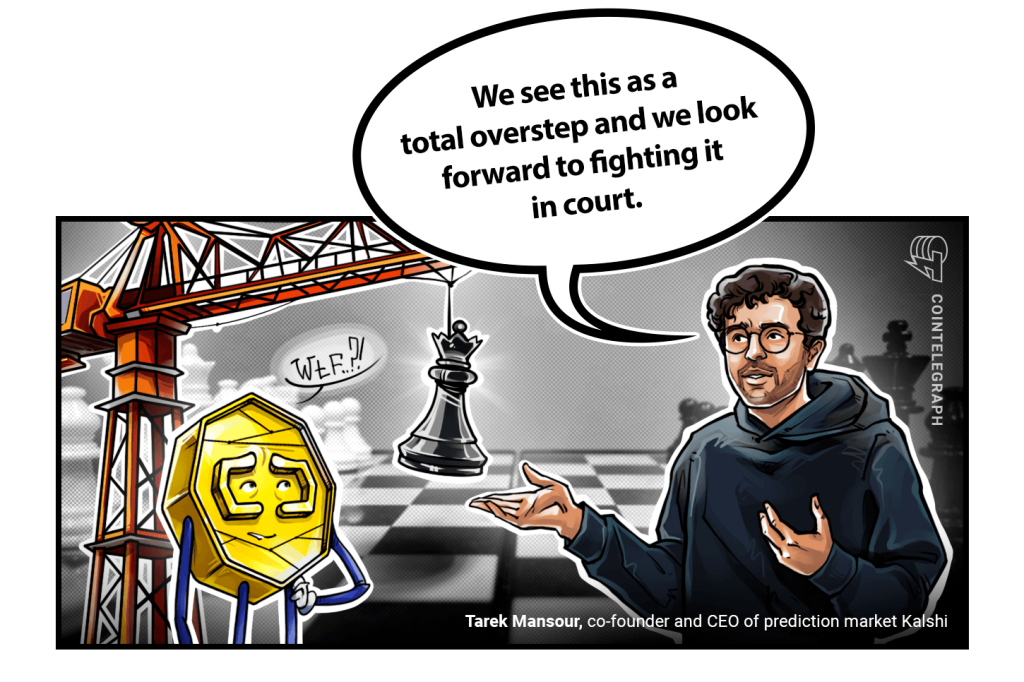
“We see this as a total overstep and we look forward to fighting it in court.”
Tarek Mansour, co-founder and CEO of prediction markets platform Kalshi
“Some of the people that have been very dug in on the issue of yield versus rewards have been working closely with the White House […] working with our members who have been trying to come up with a compromise on that issue. We think we’ve got it.”
Cynthia Lummis, Wyoming Senator
“The mandate is technologically impossible for non-custodial wallets. Hardware wallets are specifically designed so that no one, including the manufacturer, can access or recover a user’s seed phrase.”
Bitcoin Policy Institute (BPI)
“For now, traders are expecting a bullish relief rally in spite of no changes being made.”
Santiment, crypto sentiment platform

Winners and Losers
At the end of the week, Bitcoin (BTC) is at $70,448, Ether (ETH) at $2,155 and XRP (XRP) at $1.44. The total market cap is at $2.42 trillion, accordingto CoinMarketCap.
Among the biggest 100 cryptocurrencies, the top three altcoin winners of the week are DeXe (DEXE) at 28.42%, Artifical Superintelligence Alliance (FET) at 28.56% and Kaspa (KAS) at 20.10%. The top three altcoin losers of the week are Official Trump (TRUMP) at 15.63%, Midnight (NIGHT) at 11.03% and Stable (STABLE) at 10.89%.
For more info on crypto prices, make sure to read Cointelegraph’s market analysis.
Top Prediction of The Week
Bitcoin RSI signals potential bottom as analysts flag key setup
New analysis covering relative strength index (RSI) data on BTC/USD concludes it could soon be “time to pay attention.”
Bitcoin bear-market bottoms often follow the start of a bullish divergence with RSI on weekly time frames.
For trader Jelle, current market behavior is following historical trends, and Bitcoin’s next inflection point may be around the corner.
Read also
“When $BTC’s weekly RSI makes a higher low again, it’s time to pay attention,” he wrote on X.
A classic bullish divergence locks in when RSI makes a higher low while price makes lower lows. Jelle, however, says that price has room to maneuver and still preserve the emerging recovery.
“Doesn’t matter if BTC makes a higher low, equal low, or lower low,” he continued.
Top FUD of The Week
Hong Kong retiree loses $840K in triple ‘crypto expert’ scam
A 66-year-old Hong Kong retiree lost 6.6 million Hong Kong dollars (roughly $840,000) in a string of three related crypto investment scams after repeatedly trusting self-proclaimed “virtual currency experts” who reached out via WhatsApp, according to Hong Kong police’s CyberDefender unit.
In a March 20 Facebook post, police said the victim was first approached in September 2025 by a scammer who cold messaged, claiming to be a “virtual currency investment expert” and promising steady gains if the victim followed his advice. The retiree then transferred $180,000 and deposited crypto into a wallet the scammer controlled, only to watch him disappear, prompting the filing of a police report.
The case shows how fraudsters can recycle the same victim through successive schemes that start with “guaranteed profit” pitches and escalate into offers to recover funds that have already been stolen.
Bitcoin mining difficulty falls 7.7% as miner pressure persists
Bitcoin’s mining difficulty fell by around 7.7% at the latest adjustment on March 20 to 133.79 trillion at block 941,472, the sharpest drop since February, according to CoinWarz data.
Read also
The latest move takes difficulty down from around 145 trillion in mid-March and roughly 148 trillion at the start of the year. A lower difficulty means it takes less computational work to earn the same block reward, slightly improving revenue per unit of hashrate for firms that stay online.
The adjustment followed slower-than-target block production over the prior 2,016 blocks. CloverPool data showed average block times at about 12 minutes 36 seconds, well above Bitcoin’s 10-minute target, forcing the network to recalibrate lower.
In February, difficulty dropped sharply after weather-related disruptions in the United States temporarily knocked large American mining facilities offline, and it later rebounded by about 15% as hashrate returned to the network once power conditions normalized.
Appeals court denies Kalshi request to block Nevada enforcement action
A federal appeals court has cleared Nevada state authorities to enforce a temporary restraining order against Kalshi, blocking its sports-event contracts.
The Ninth Circuit Appeals Court on Thursday denied Kalshi’s emergency request to stay a lower court proceeding, meaning the case returns to federal court and allows Nevada regulators to take action.
Gaming lawyer Daniel Wallach said a temporary restraining order (TRO) against Kalshi now appears imminent, and added that it wouldn’t be able to operate in Nevada for at least 14 days until a preliminary injunction hearing is held:
“Since a TRO is not appealable under Nevada law, Kalshi would be required to exit the state in the interim.”
Top Magazine Stories of The Week
Are DeFi devs liable for the illegal activity of others on their platforms?
The Uniswap ruling may reinforce the “neutral infrastructure” argument, but global regulatory standards are taking a tougher line on DeFi developers.
Animoca teams up with Ava Labs, Shrapnel on Steam: Web3 Gamer
Ava Labs sets its sights on Asia and the Middle East, Shiny Labs CEO Brenden Hammond claims “Web3 gaming founders were essentially tourists,” and other news.
Big Questions: Can Bitcoin save you from the dreaded Cantillon Effect?
Why are the rich getting richer and the poor getting poorer? Take a seat, it’s time you learned about the Cantillon Effect.
Subscribe
The most engaging reads in blockchain. Delivered once a week.

Disclaimer
Cointelegraph Magazine publishes long-form journalism, analysis and narrative reporting produced by Cointelegraph’s in-house editorial team with subject-matter expertise.
All articles are edited and reviewed by Cointelegraph editors in line with our editorial standards.
Content published in Magazine does not constitute financial, legal or investment advice. Readers should conduct their own research and consult qualified professionals where appropriate. Cointelegraph maintains full editorial independence.
Read also

Silicon Valley Bank down, USDC depegged, FTX billed $34M in Jan.: Hodler’s Digest, March 5-11
Bank run on Silicon Valley Bank, USDC depegged from U.S. dollar and FTX’s bankruptcy expenses hit $34 million in January.

Crypto’s ‘pro-rioter’ glitch artist stirs controversy — Patrick Amadon, NFT Creator
NFT artist Patrick Amadon is proudly “pro-rioter,” as Hong Kong Art Week discovered, and he’s at home in crypto, where everyone’s a rebel.
Go to Source to See Full Article
Author: Editorial Staff