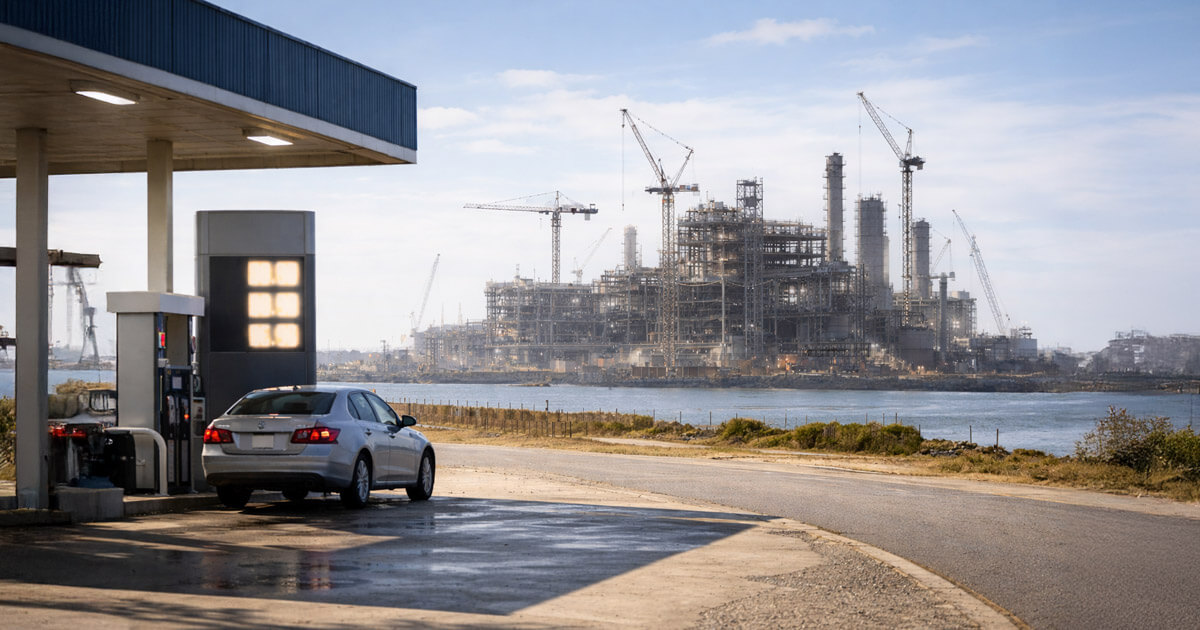
President Donald Trump’s announcement of the first major new US oil refinery in nearly 50 years arrives as gasoline prices have become a political problem and energy has turned inflationary again.
The Brownsville project is being pitched as an industrial revival and consumer relief. Still, the sharper question is whether a refinery that won’t produce fuel for years can address the inflationary pressures now.
Sustained energy-driven price pressure can keep the Fed more cautious, tightening liquidity conditions for risk assets like Bitcoin. At the same time, some investors still view persistent inflation and geopolitical commodity shocks as part of the longer-term case for scarce, non-sovereign assets.
A historic first meets a same-week price shock
Trump said a 168,000-barrel-per-day refinery will be built at the Port of Brownsville, Texas, backed by India’s Reliance Industries, with a binding 20-year offtake term sheet and a plan to break ground in the second quarter of 2026.
The company described the project as improving the US-India trade balance by $300 billion, breaking that figure down into $125 billion in shale oil purchases, $175 billion in refined-product value, and a claimed $300 billion improvement in the bilateral deficit.
Reuters reported the company disclosed a nine-figure investment at a ten-figure valuation, while typical refinery construction math implies approximately $6.7 billion for a plant of this size.
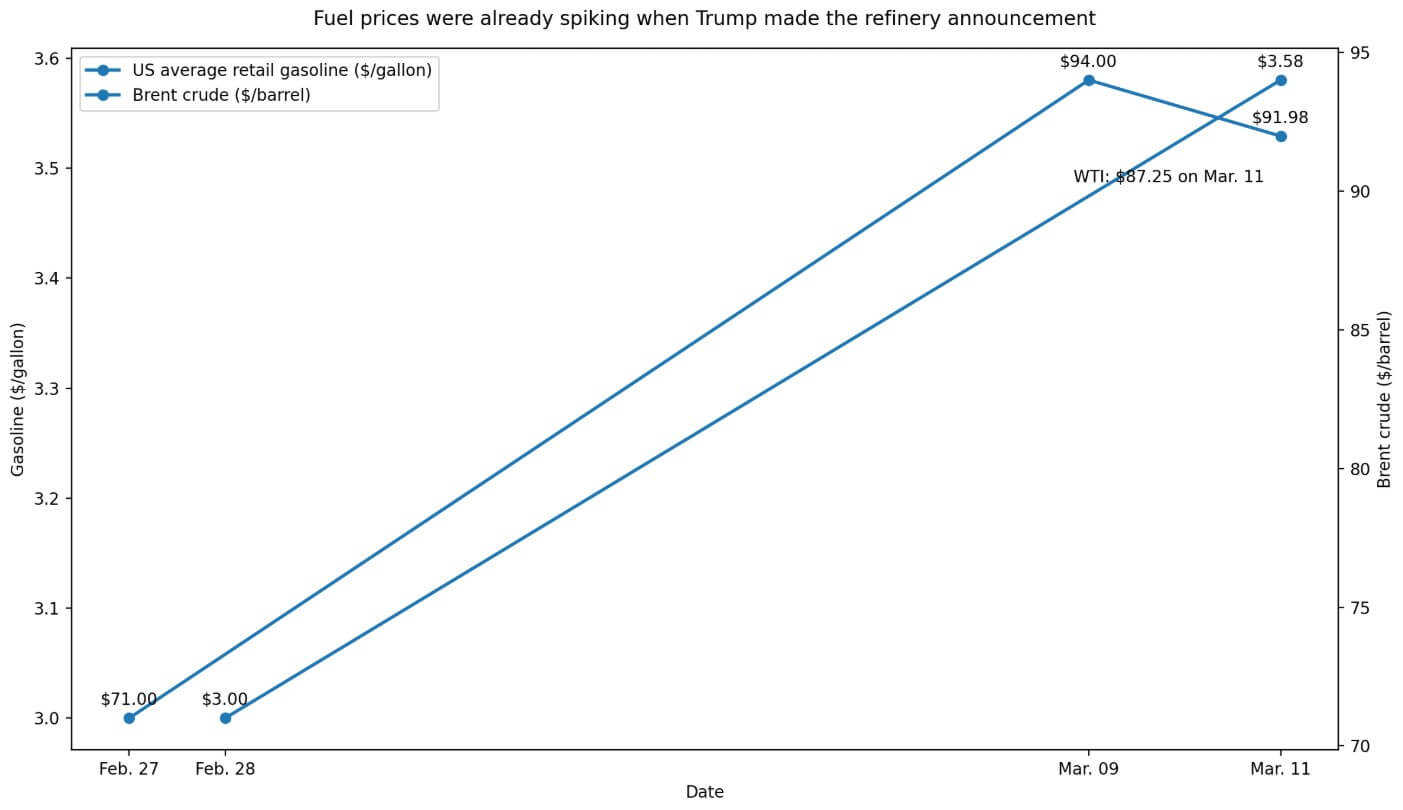
The announcement landed as the US average retail gasoline price hit $3.58 per gallon on Mar. 11, up nearly 60 cents since Feb. 28.
The US refining system faces a genuine configuration mismatch.
The Energy Information Administration says many American refineries were optimized for heavier, sour crude, while much of US production consists of light, sweet shale oil.
That helps explain why US crude exports hit another record in 2024 at more than 4.1 million barrels per day even as the country remained a net crude importer.
US refining capacity stood at 18.4 million barrels per calendar day as of Jan. 1, 2025, essentially flat year over year. The newest refinery with significant downstream capacity is Marathon’s Garyville plant, which came online in 1977.
Brownsville would represent a genuine greenfield expansion in a system that has mostly grown through debottlenecking and upgrades.
Reuters reported in June 2024 that entrepreneur John Calce was already working to build a large South Texas refinery under the Element Fuels banner. The current America First Refining materials still reference Element Fuels’ work, suggesting Trump elevated a pre-existing Brownsville concept into a national energy symbol.

Why energy inflation still matters for Bitcoin
Oil shocks rarely stay confined to fuel markets. Rising crude prices feed directly into headline inflation through gasoline, transportation, and production costs, complicating central bank policy and delaying interest-rate cuts.
That affects crypto because liquidity conditions remain one of the biggest macro drivers of Bitcoin’s price cycle. When inflation accelerates and the Federal Reserve turns more cautious about easing, risk assets often lose some of the monetary tailwinds that supported the 2023–2025 rally.
Recent geopolitical tensions have already made oil extremely volatile, raising concerns that energy inflation could force policymakers to keep rates elevated longer than markets expected.
In the short term, that dynamic tends to pressure speculative assets. Traders often treat Bitcoin more like a high-beta macro trade than a pure inflation hedge, meaning rising oil and hotter CPI prints can trigger risk-off positioning across crypto markets.
Over longer horizons, however, some investors still frame persistent commodity shocks and monetary instability as part of the structural argument for scarce digital assets. The result is a paradox: energy inflation can weaken Bitcoin in the near term while reinforcing its narrative over the long run.
Consumer-relief frame runs into timing problems
The political promise is immediate, but the impact on physical supply is years away.
Groundbreaking is planned for the second quarter of 2026, which means any material fuel output will be in the latter part of the decade, while gasoline pain is happening now.
Reuters quoted analyst Tom Kloza saying that if Brownsville is the build site, he would assume it is an export refinery because there is limited local demand and no pipeline connections to move product inland.
That shifts the narrative from “Trump found a way to lower domestic pump prices” to “Trump is marketing an export-oriented refining project as an affordability answer.”
EIA’s Mar. 10 outlook said Brent jumped from $71 on Feb. 27 to $94 on Mar. 9 and forecast it would stay above $95 for the next two months.
Republicans already fear higher fuel prices could damage them in the midterms. The refinery gives Trump a fresh energy symbol at a moment when voters care most about pump prices. Still, the timetable disconnect remains: the politics are now, the molecules are later.
The US Trade Representative says the US goods trade deficit with India was $58.2 billion in 2025.
The project’s claimed $300 billion improvement is more than five times last year’s bilateral deficit, which helps explain why the figure serves better as political packaging than as a disclosed refinery cost.
| Metric | What’s claimed / disclosed | Why it matters |
|---|---|---|
| Planned capacity | 168,000 bpd | Confirms this is a real major-project proposal, not a token facility |
| Groundbreaking target | Q2 2026 | Shows the long lead time between announcement and any real supply impact |
| Offtake | 20-year binding term sheet | Adds credibility and suggests long-term commercial planning |
| Trade-balance claim | $300 billion | Better understood as political/economic-impact framing than as stated refinery capex |
| Claim breakdown | $125B shale purchases + $175B refined-product value | Explains how the headline number was assembled |
| Disclosed investment language | Nine-figure investment / ten-figure valuation | Much smaller than a literal reading of “$300B refinery” |
| Comparable construction math | ~$6.7 billion implied for a plant this size | Shows why analysts questioned the economics |
| US-India goods trade deficit (2025) | $58.2 billion | Shows the claimed $300B impact is more than 5x last year’s bilateral deficit |
India’s Reliance backing a 20-year offtake commitment suggests the refinery is designed to serve both domestic shale monetization and long-term export flows.
On Mar. 11, Brent settled at $91.98 and WTI at $87.25, while stocks dipped and strategists said higher energy prices could squeeze margins and force investors to rethink 2026 earnings assumptions. HSBC lifted its 2026 Brent forecast to $80 from $65.
Markets are reacting to the risk that 20% of global fuel supply could be disrupted through the Strait of Hormuz, while Iran warned the world should be ready for $200 oil.
That turns the Brownsville announcement into something bigger than a single construction project. Trump is trying to convert refinery capacity into a political answer to three problems simultaneously: gasoline inflation, energy security optics, and the trade deficit with India.
Absorption scale and the political test
US refinery utilization had already risen to 91% in mid-February, while gasoline demand climbed to 8.75 million barrels per day.
That suggests the American refining system is being worked harder to meet stronger demand, which weakens any claim that a newly announced refinery will change the 2026 consumer picture.
The IEA’s February 2026 Oil Market Report forecast that world oil supply would rise by 2.4 million barrels per day in 2026 to 108.6 million barrels per day. That makes the strongest defense of Brownsville not “the world desperately needs more refining” but “the US needs better-configured refining for its own crude slate.”
Supporters sell Brownsville as an industrial revival: America is finally building a refinery tailored to domestic shale rather than exporting light crude.
Meanwhile, skeptics characterize it as campaign-stage theater: an export-leaning project with uncertain economics presented as a consumer-price solution it cannot deliver soon.
Analysts questioned the economics and noted that early Trump administration announcements can contain “a lot of hyperbole,” while the company disclosed a binding offtake commitment and a concrete timeline for groundbreaking.
The base case resembles a political symbol meets a delayed industrial payoff.
| Scenario | Oil / market backdrop | What Brownsville means politically | What it means for pump prices |
|---|---|---|---|
| Base case | Oil cools as EIA expects after the current shock | Trump gets an energy-dominance symbol and an industrial-revival talking point | Most relief comes from crude normalization, not Brownsville itself |
| Bear case | Hormuz disruption persists and gasoline stays above $3.50 | Project looks more like optics than relief | Little near-term consumer benefit; refinery timeline becomes a liability |
| Bull case | Conflict eases quickly and oil falls faster than feared | Trump can claim both symbolic industrial momentum and lower prices | Lower prices still come mainly from easing crude risk, not new Texas molecules |
Brownsville moves through early-stage work, oil cools as EIA expects, and the story becomes: Trump used a long-cycle refinery build to demonstrate energy dominance, but actual pump relief comes from crude normalization rather than new Texas molecules.
The bear case sees prolonged conflict and sustained price pressure.
If the Strait of Hormuz stays impaired and gasoline remains above $3.50, Brownsville reads less like relief and more like optics.
Converting industrial policy into inflation politics
Trump’s Brownsville announcement matters less as a construction story than as a macro-political test.
The project tries to sell a historic “first major refinery in nearly 50 years” as proof that fossil-fuel expansion can ease energy anxiety and inflation pressure, even though any real supply effect is years away.
Trump is trying to turn refinery capacity into an answer for inflation, trade, and energy security all at once, converting a long-dated industrial project into a same-week response to gasoline sticker shock and geopolitical oil risk.
Brownsville may be a real industrial project with genuine strategic logic around shale processing and export flows, but the consumer-pump promise is political because the timetable is measured in years.
Trump gets the energy symbol now. Voters could get measurable fuel-cost relief, depending on variables the Brownsville announcement cannot control: how quickly the Iran conflict resolves, how oil markets price risk through 2026, and whether a refinery designed partly for export can function as the domestic affordability answer Trump is selling.
For markets beyond energy, the inflation dynamic always feeds back into crypto.
If sustained oil-driven price pressure forces the Federal Reserve to stay cautious on rate cuts, liquidity conditions that supported Bitcoin’s recent rallies could tighten again.
In that sense, the Brownsville refinery announcement sits at the intersection of politics, energy markets, and macro liquidity: the project may take years to produce fuel, but the inflation narrative around oil prices can influence risk assets like Bitcoin almost immediately.
Go to Source to See Full Article
Author: Gino Matos