
BNB Chain activated its Fermi hard fork on 14 January 2026 at 02:30 UTC, marking one of its most significant performance upgrades since the network’s Pascal and Maxwell releases.
The upgrade will reduce block times from 0.75 seconds to 0.45 seconds, bringing BNB Smart Chain closer to the fastest production speeds among major blockchains.
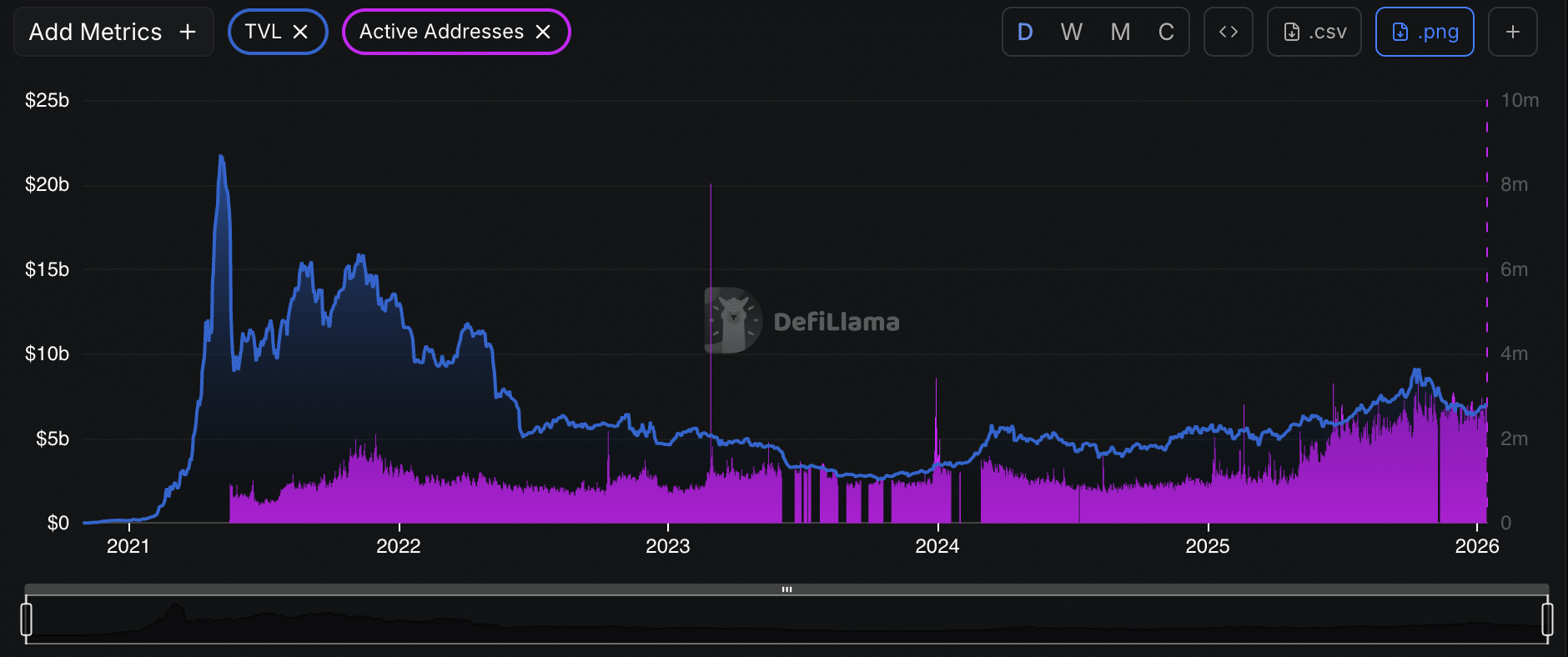
But the timing of the upgrade is not just technical. It arrives as BNB Chain usage has surged back toward levels last seen during the 2021 bull market, even though total value locked [TVL] remains far below its previous peak.
This combination puts growing strain on the network.
BNB Chain users are back — but capital hasn’t fully followed
Data from DefiLlama shows a sharp rise in active addresses on BNB Chain throughout 2025 into early 2026.
Daily active addresses have climbed into the 2–3 million range, approaching the highs recorded during the DeFi and retail trading boom of 2021.
However, the capital backing that activity tells a different story.
Source: DefiLlama
BNB Chain’s TVL has recovered only modestly, rising to roughly $7bn compared with a peak above $20bn in 2021. In other words, the network now supports a much larger number of users with far less liquidity per user.
That imbalance matters. High transaction volume with thinner liquidity increases the risk of:
- network congestion
- failed or delayed transactions
- MEV spikes
- unstable DeFi execution
- It is exactly this environment that Fermi is designed to address.
What the BNB Chain Fermi hard fork changes
The Fermi upgrade introduces a package of protocol improvements aimed at keeping BNB Chain stable as transaction throughput rises.
The headline change is BEP-619, which cuts block times from 0.75 seconds to 0.45 seconds, allowing the network to process blocks nearly 40% faster.
Alongside that, BEP-590 strengthens fast-finality voting rules. This ensures that blocks reach irreversible status reliably even as they are produced more frequently. This is crucial for DeFi and trading platforms that rely on rapid, predictable settlement.
Why this upgrade is happening now
BNB Chain has already demonstrated it can handle high TVL. The challenge it faces now is high-velocity usage with thinner liquidity buffers.
With millions of users transacting daily but far less capital locked in smart contracts than during the last cycle, the margin for error is much smaller.
Delays, congestion, or finality issues would have a much greater impact on traders, protocols, and consumer apps.
What happens next
Validators and node operators were required to upgrade to BSC v1.6.4 or later ahead of the 02:30 UTC activation. Following the fork, nodes will regenerate snapshots and re-index logs on first startup.
As activity continues to climb, the success of Fermi will be a key test of whether BNB Chain can remain competitive as one of the world’s most heavily used blockchains.
Final Thoughts
- BNB Chain activated the Fermi hard fork on 14 January 2026, introducing faster block times and stronger finality as network usage climbs back toward 2021 levels.
- Active addresses have surged while TVL remains far below its peak, making performance upgrades essential to support high-volume DeFi, trading, and consumer activity.
Go to Source to See Full Article
Author: Adewale Olarinde