
Bitcoin [BTC] has maintained a position above the $90,000 level since the 3rd of January, though the asset has yet to break decisively through the $92,500 zone.
While this consolidation phase persists, the prospects for a more robust rebound and a potential return to the $100k threshold and beyond appear increasingly linked to macroeconomic developments alongside institutional participation.
Economic inputs begin to carry weight
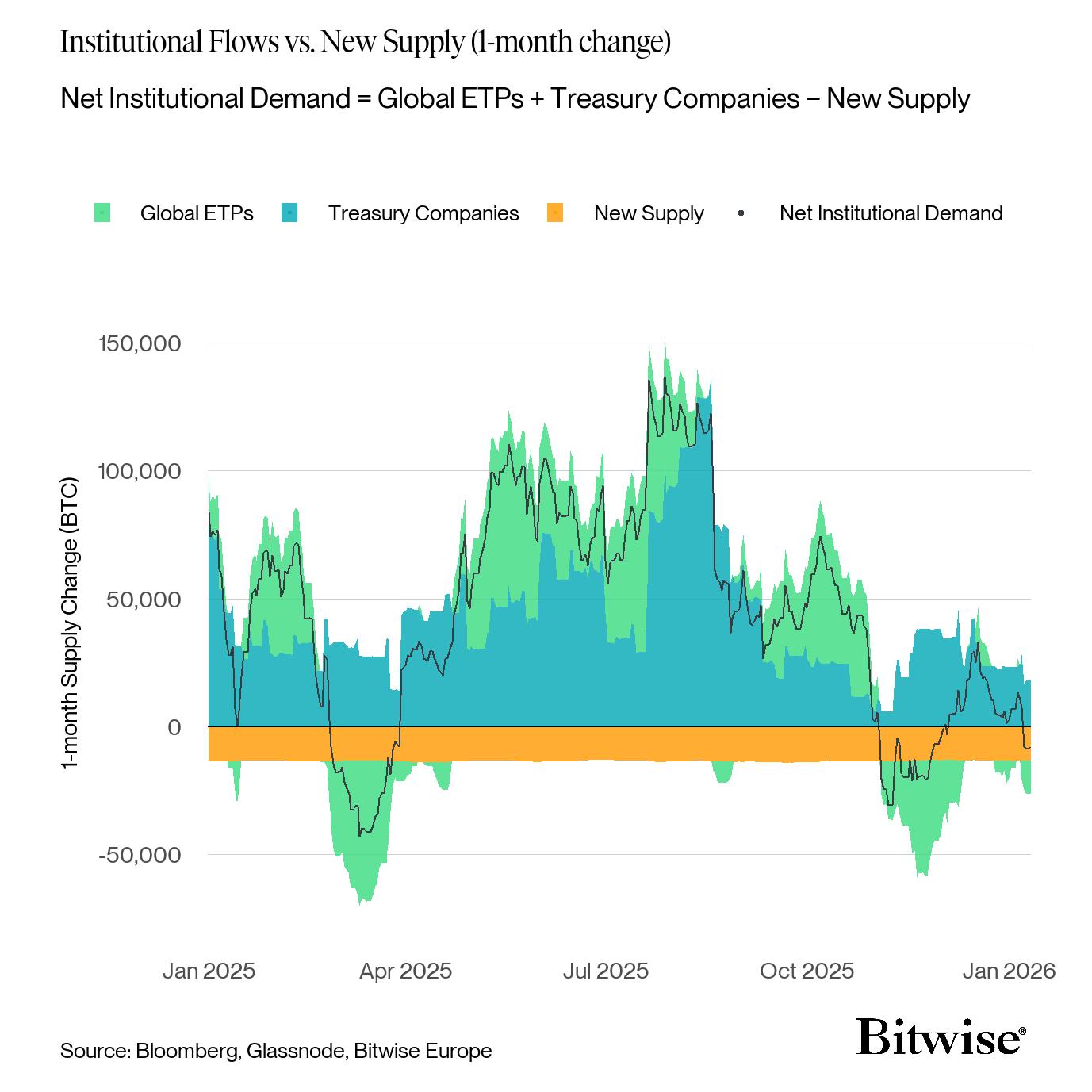
Recent analysis from Bitwise indicates that Bitcoin’s sustained weakness and subdued price action stem largely from tepid institutional demand.
The data reveals that insufficient inflows from large-scale investors have played a significant role in constraining Bitcoin’s upward movement.
Bradley Duke, Managing Director of Bitwise Europe, emphasized this dynamic in a post on X, questioning whether Bitcoin’s recent trajectory reflected not deteriorating liquidity or long-term holder distribution, but rather a broader pullback tied to waning institutional interest.
Andre Dragosch, Head of Research at Bitwise Europe, corroborated this assessment with supporting data. He demonstrated that the apparent demand shortfall resulted primarily from institutional investors adopting a more cautious stance.
Dragosch observed:
“Interesting finding — it implies that it’s not ‘deteriorating liquidity,’ ‘long-term holder selling,’ ‘the end of the halving cycle,’ or ‘quantum risk’ that led to this drawdown, but simply a deceleration in institutional demand.”
Source: X
Institutional investors characteristically respond with sensitivity to economic data when making allocation decisions. When economic sentiment deteriorates, risk appetite tends to contract, prompting large funds toward more defensive positioning.
That dynamic may now be evolving. Recent U.S. unemployment figures declined from 4.5% to 4.4% at press time. This indicates strengthening labor market conditions.
Firmer employment data typically signals underlying economic health and improving investor confidence, which can elevate risk appetite while potentially creating conditions for future Federal Reserve rate reductions.
Such developments could restore market confidence, draw fresh liquidity into the system, and underpin stronger performance across risk assets, Bitcoin among them.
How institutional investors are positioning
Institutional and corporate activity continues to provide a dependable indicator of prevailing market sentiment, offering insight into whether conditions favor bullish or bearish positioning.
U.S. institutional demand carries particular weight, given that large investors maintain their Bitcoin exposure predominantly through exchange-traded funds and collectively oversee more than $126 billion in assets. Their positioning offers a transparent view into market confidence levels.
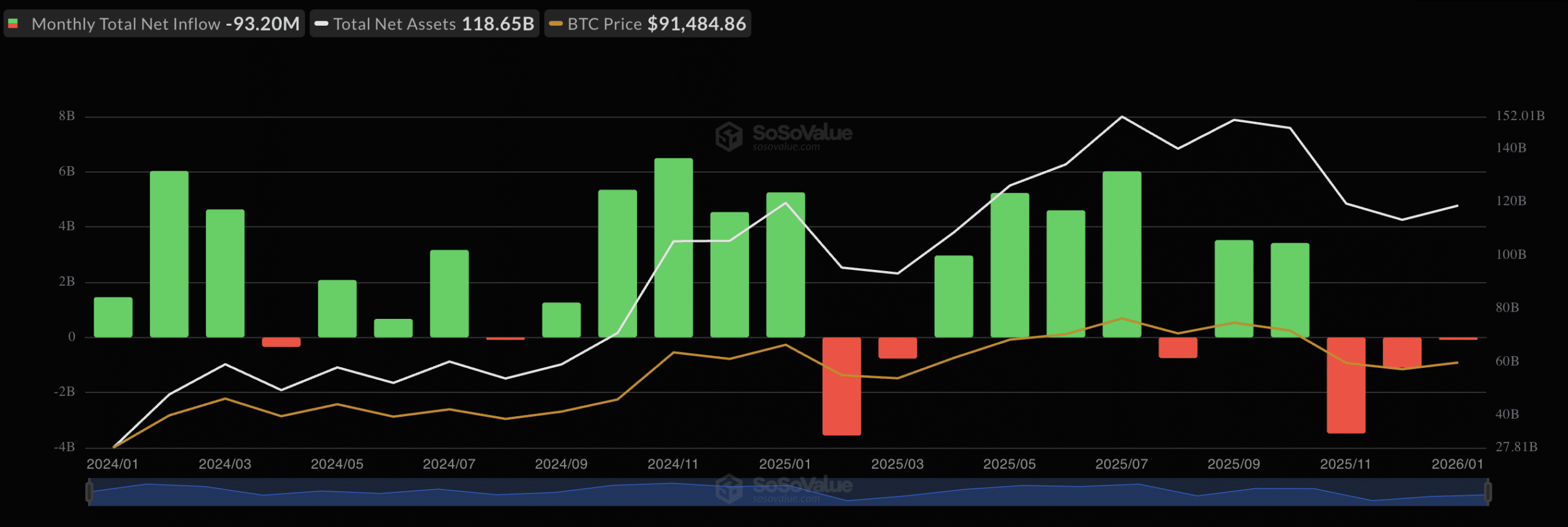
Monthly, U.S. spot Bitcoin ETFs have experienced their most substantial consecutive outflows on record. From November 2025 through the present, the market has witnessed net outflows totaling $4.66 billion in Bitcoin.
Source: Sosovalue
These outflows, while significant, are not entirely without historical parallel.
A comparable period unfolded between February and March 2025, when $4.32 billion departed the market. During that interval, Bitcoin’s price contracted by 25%, declining from its February peak of $102,783 to $76,606.
The January trajectory of U.S. spot Bitcoin ETFs is emerging as a key indicator of investor sentiment. Although aggregate net outflows for the month totaled $93 million, at press time, the trading session ending on the 12th of January recorded a notable inflow of $116.67 million.
This shift coincided with a decline in U.S. unemployment, suggesting that improving economic conditions may already be shaping institutional decision‑making.
Corporate holdings, meanwhile, have demonstrated relative stability. Notably, the total Corporate Bitcoin Reserves stood at 4.06 million BTC, reflecting a 1.06% increase over the preceding 30 days.
This pattern is consistent with measured accumulation rather than aggressive distribution.
The retail investor dynamic
While institutional demand functions as the principal driver behind major price movements, other market participants continue to shape short-term dynamics. Retail investors represent a meaningful segment of the market ecosystem.
Spot exchange netflow provides one of the clearest windows into retail behavior. This metric captures the movement of Bitcoin into and out of centralized exchanges, offering a perspective on potential buying or selling pressure.
Weekly netflows have largely reflected positive sentiment. From early December through the week ending the 5th of January, investors maintained a constructive outlook, with steady accumulation helping to stabilize Bitcoin’s near‑term price.
In contrast, since the 12th of January, netflows have shown a different trend, with $58.24 million in net outflows signaling that some participants are reducing positions.
Although the week is still underway, this shift highlights the need to closely monitor retail behavior, as it can quickly shape Bitcoin’s short‑term price trajectory.
Final Thoughts
- U.S. unemployment data points to market conditions that could support risk assets like Bitcoin in the short term.
- Institutional demand remains central to lifting Bitcoin’s price.
Go to Source to See Full Article
Author: Olayiwola Dolapo