Bitcoin [BTC] has spent the past year being pulled in two directions. One is Wall Street’s neatly packaged ETFs, the other is back to its roots of “not your keys, not your coins.”
And instead of choosing a side, the crowd is choosing to embrace both.
In 2025, the real Bitcoin strategy isn’t maximalist or institutional. It’s a split personality that finally makes sense.
ETFs vs. self-custody
ETFs have become the most convenient doorway into Bitcoin for a growing class of investors who want exposure without the hassles of private keys.
Institutional access, deep liquidity, and integration with retirement accounts have turned them into the default entry point.
Source: SoSoValue
And the numbers back that up.
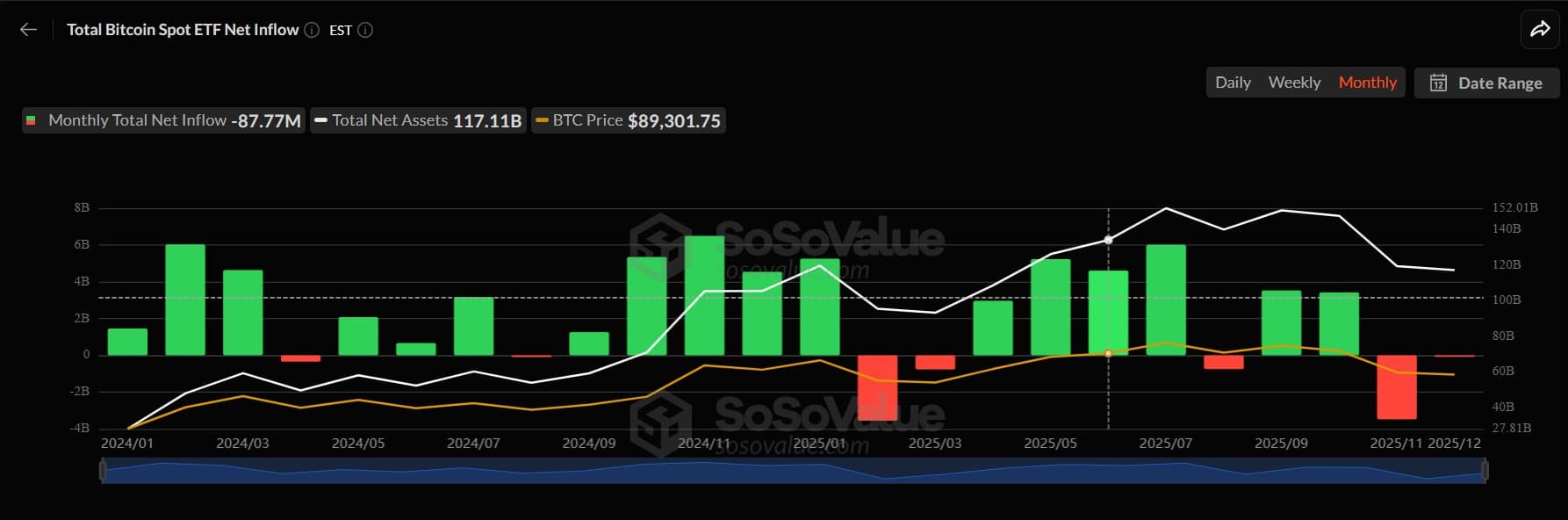
Across 2024 and most of 2025, monthly spot Bitcoin ETF flows were overwhelmingly positive, with multiple months posting $4B to $6B inflows. This is especially during late 2024 and mid-2025.
Even total net assets climbed steadily toward the $140B range by July 2025, so institutional allocations are aggressive.
ETF analyst Eric Balchunas seems to agree, saying in an X post,
“What I don’t understand is why the snobby OG’s were totally fine with crypto exchanges holding your bitcoin and not ETFs? It’s the same outsourced custody concept, except ETFs are waaay cheaper and safer.”
For many new investors, that clarity is important. Bitcoin held in an ETF feels familiar and regulated. And that, packaged for the TradFi world, seems to be exactly what a large part of the market wants.
However, for long-time Bitcoin users, the appeal has always been sovereignty. That’s why self-custody remains non-negotiable for many OGs, even as ETFs gain mainstream momentum.
As Sam Wouters, Director of Marketing at River, put it,
“On an exchange you can withdraw to self-custody at any time, that’s not the case with an ETF.”
That freedom of movement is the core of this side of the argument. To them, “snobby OGs love bitcoin as money that creates freedom.”
To them, an ETF is a bird in a cage.
The new middle ground
The custody debate ultimately comes down to one thing: control.
Early Bitcoiners tolerated keeping coins on exchanges because, at any moment, they could pull them out and return to full sovereignty. ETFs don’t offer that. They package Bitcoin but lock away the ability to ever touch it.
That’s why a new dual-strategy is emerging. As Bitcoin maxi Fred Krueger puts it,
“The answer is BOTH: welcome adoption by Banks, ETFs and the greater establishment… and at the same time encourage and practice self-custody. And defend the right to self-custody.”
Investors today use ETFs for ease and cold wallets for principle. This is a balance that proves that Bitcoin is maturing.
AMBCrypto previously reported that 2025 has already logged 171 negative Bitcoin days, potentially pushing the market into a sideways pattern.
With corporate treasuries now holding over 1 million BTC (more than major exchanges, mind you), this growing base is starting to act as a new structural floor for the asset.
ETFs are a structural part of the Bitcoin market
Go to Source to See Full Article
Author: Samyukhtha L KM