Lazaro 2026 03 15T102053592

A $50.4 million swap on the 12th of March exposed how fragile liquidity can become in decentralized finance. The trade began through CoW Swap and then moved toward a SushiSwap AAVE/WETH pool connected to Aave.

At that moment, the pool held only 331.63 AAVE and 17.65 WETH, roughly $73,000 in depth.

As the router injected 17,957.81 WETH, automated market maker (AMM) pricing pushed the curve sharply out of balance. The execution value collapsed, and the trader received only 327 AAVE, worth approximately $36,000.
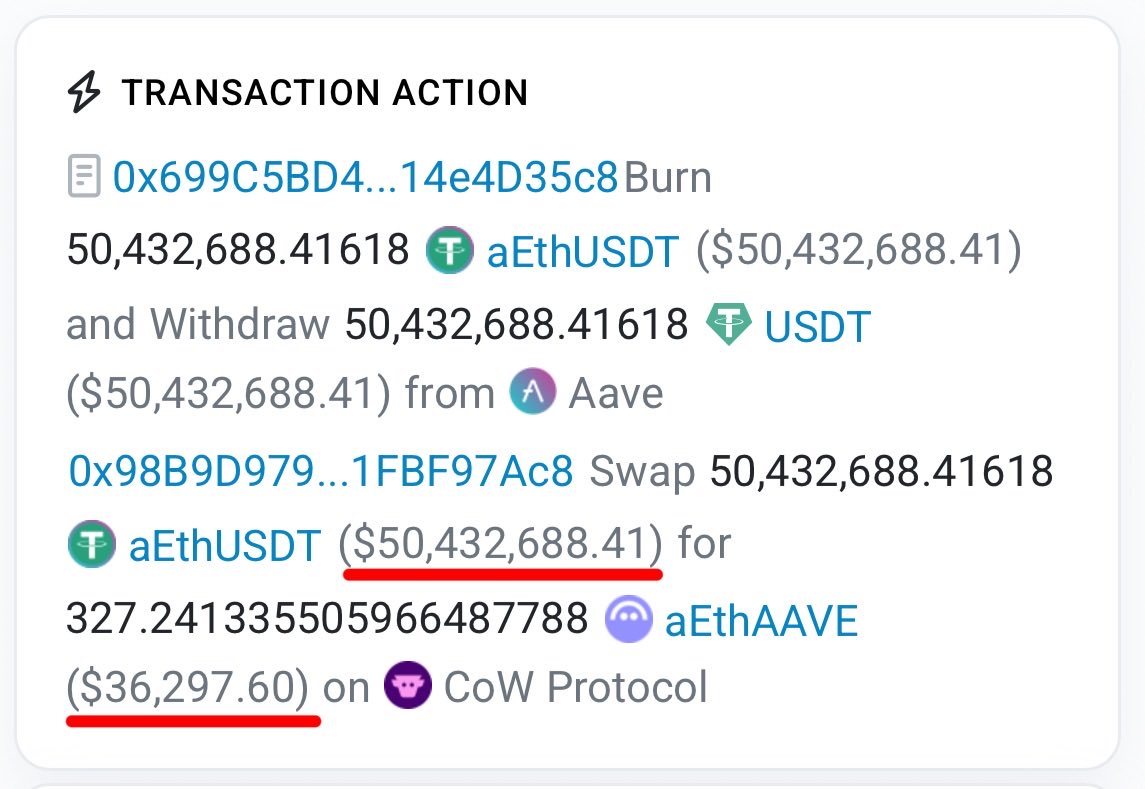
Transaction showing USDT/Aave slippage

Source: X

Meanwhile, deeper decentralized venues processed similar flows with less than 1% slippage, highlighting a clear liquidity gap. That imbalance raised concerns about routing safeguards and user protection.

In response, Aave [AAVE] introduced Aave Shield, signaling a shift toward stronger protocol-level defenses against extreme execution shocks.

Aave deploys swap-level risk protection

Following the $50.4 million swap that produced a 99.9% price impact, the DeFi protocol moved to reinforce user safeguards without weakening permissionless finance.

The incident demonstrated how unrestricted execution can amplify risk when liquidity depth is thin.

At the same time, Aave maintained that traders must retain the ability to execute swaps even under extreme slippage. In response, the protocol introduced Aave Shield, which automatically blocks trades with a price impact above 25%.

From there, users must deliberately disable the protection before proceeding with high-risk execution.

Meanwhile, the transaction generated $110,368 in swap fees at a 25 basis-point rate, which the interface now holds pending verification. Through this adjustment, Aave strengthens user protection while preserving open market access.

Risk safeguards push DeFi toward institutional-grade infrastructure

Institutional adoption in DeFi is becoming more reliant on predictable execution and built-in protections. Recent protocol adjustments reflect this shift toward stronger risk management.

According to DefiLlama, Aave holds approximately $25.53 billion in Total Value Locked, with $21.67 billion on Ethereum [ETH] and $17.17 billion in active loans, indicating deep and reliable collateral markets.

Across the broader $96.28 billion DeFi ecosystem, layered safeguards have contained cumulative exploit losses to $15.85 billion, even as capital inflows expanded rapidly.

However, stronger protections also introduce structural trade-offs.

Governance participation remains limited, while $330.97 million in staked AAVE, roughly 19.6% of market capitalization, concentrates influence among fewer stakeholders.

Despite these constraints, embedded risk controls are steadily transforming DeFi from experimental liquidity pools into structured financial infrastructure.


Final Summary

  • Aave [AAVE] is shifting toward protocol-level risk controls after a $50.4 million swap exposed severe liquidity fragility and a 99.9% price impact in shallow decentralized pools.
  • Aave safeguards such as Aave Shield and deeper execution protections highlight DeFi’s transition from experimental liquidity venues toward structured financial infrastructure.

Go to Source to See Full Article
Author: Muriuki Lazaro

BTC NewswireAuthor posts

BTC Newswire Crypto News at your Fingertips

Comments are disabled.