A new report warns that the Central African Republic’s crypto push favored elites and exposed the country to foreign criminal networks, rather than boosting financial inclusion.

News
The Central African Republic’s push into crypto has deepened elite control and exposed the country to “foreign criminal organizations,” according to a recent report by the Global Initiative Against Transnational Organized Crime (GI-TOC).
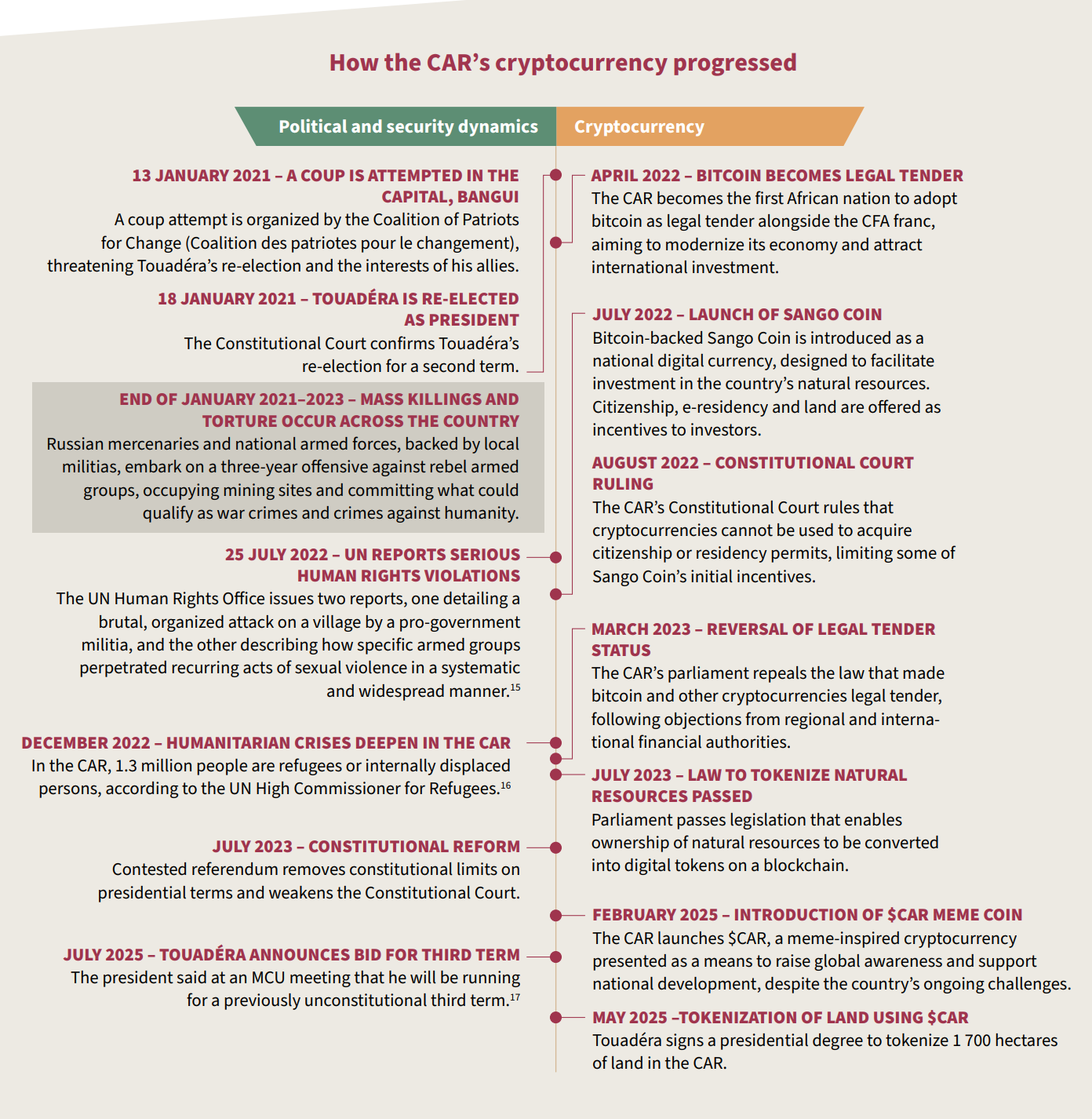
In the report titled “Behind the blockchain: Cryptocurrency and criminal capture in the Central African Republic,” researchers claimed that the CAR’s crypto ventures, from adopting Bitcoin (BTC) as legal tender to launching Sango Coin and the CAR memecoin, were rolled out in a fragile state with limited electricity, internet access and oversight.
“An impoverished population, exposed to mass executions, torture and gang rape, with limited access to electricity, mobile phones and the internet, cannot engage in crypto investments in any meaningful way,” the report stated, arguing that the programs were “tailored more to the interests of foreign investors than to the needs of its own population.”
The report specifically criticized a July 2023 law allowing the tokenization of national resources such as oil, gold, timber and land, claiming that it risks undermining the country’s sovereignty.
CAR reverses Bitcoin legal tender status after pushback
In April 2022, CAR made Bitcoin legal tender, becoming the second country to do so after El Salvador. However, the country repealed the legislation in March 2023 after significant pressure from the regional monetary union, the Economic and Monetary Community of Central Africa (CEMAC), and the International Monetary Fund (IMF).
Related: From Nairobi to Lagos: How Africans are using stablecoins to survive inflation
“The initiative was fundamentally unrealistic,” the GI-TOC said. “With just 15.7% of the population connected to electricity, 21 fewer than 40% holding mobile subscriptions and GDP per capita at only US$467,22 most citizens lacked the infrastructure and resources to trade in digital currency,” the researchers added.
The report also claimed that President Faustin-Archange Touadéra was “surrounded by crypto enthusiasts, pro-Russian businesspeople and controversial business magnates.” The report named Nicolae Bogdan Buzaianu (linked to alleged illegal timber trafficking and under investigation) and Émile Parfait Simb (linked to multiple fraud cases and convictions) as examples.
At its most severe, the report said the initiatives appear “designed to enrich a narrow circle of insiders while opening new channels for foreign influence and transnational organized crime at the expense of the wider population.”
Related: Circle taps Onafriq to cut Africa’s cross-border payment costs with USDC
CAR’s crypto projects fail to gain momentum
The GI-TOC also noted the poor performance of CAR’s crypto initiatives. In 2022, CAR announced the launch of the country’s first major crypto initiative, Sango, aimed at tokenizing natural resources and attracting crypto investment. However, according to the GI-TOC, Sango Coin sold less than 10% of its target supply.
The country’s other major crypto project was the CAR memecoin, which saw extreme volatility and even encountered technical issues. CAR is currently trading at around $0.004105, down by more than 93% over the past year, according to CoinGecko.
Magazine: 2026 is the year of pragmatic privacy in crypto — Canton, Zcash and more
Go to Source to See Full Article
Author: Amin Haqshanas