
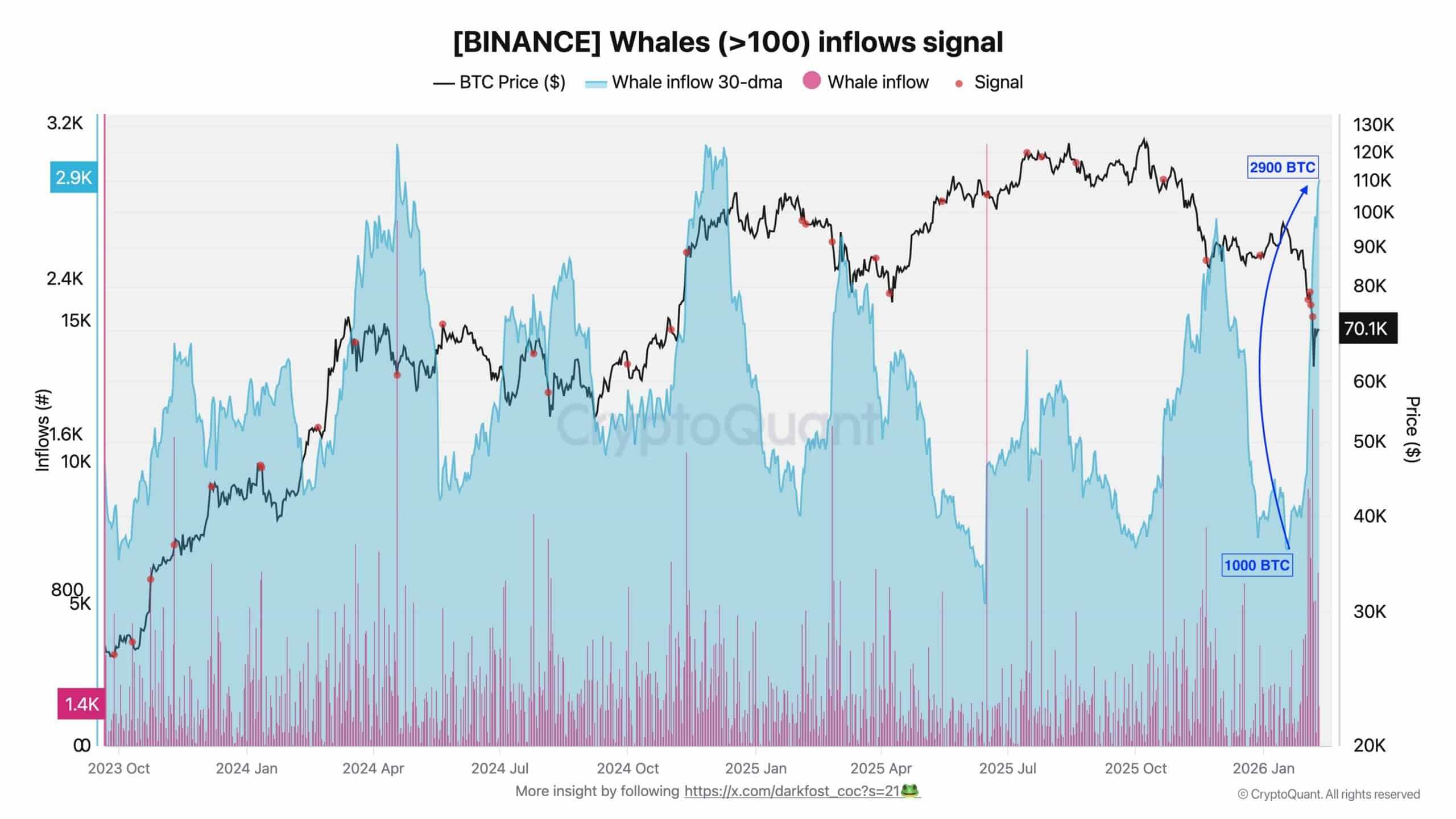
Liquidity stress rarely begins with price; it begins with whales moving supply. Whale inflows to Binance trended higher as Bitcoin [BTC] rallied through early 2024, averaging near 1,000 BTC.
As prices expanded toward cycle highs, inflows concentrated, signaling measured distribution. This trend shifted sharply during the late-2025 correction. Monthly averages climbed toward 2,900–3,000 BTC, confirming escalating exchange supply.
The 6th of February spike near 12,000 BTC stood out for its velocity and scale. Unlike routine transfers, this surge reflected urgent positioning under price stress.
It coincided with Bitcoin’s slide from $95,000 toward $60,000, amplifying sell-side liquidity and triggering derivatives short hedging.
Source: X
However, the price did not instantly collapse. Deep exchange liquidity and partial institutional absorption muted the immediate downside, delaying the impact.
Repeated spikes above 5,000 BTC signaled acceleration in defensive flows. Collectively, they expand tradable inventory, weaken bid support, and heighten volatility risk. Unless offset by cold-storage outflows or ETF demand, such concentrated inflows typically pressure BTC and broader market sentiment.
From Exchange Inflows to market execution
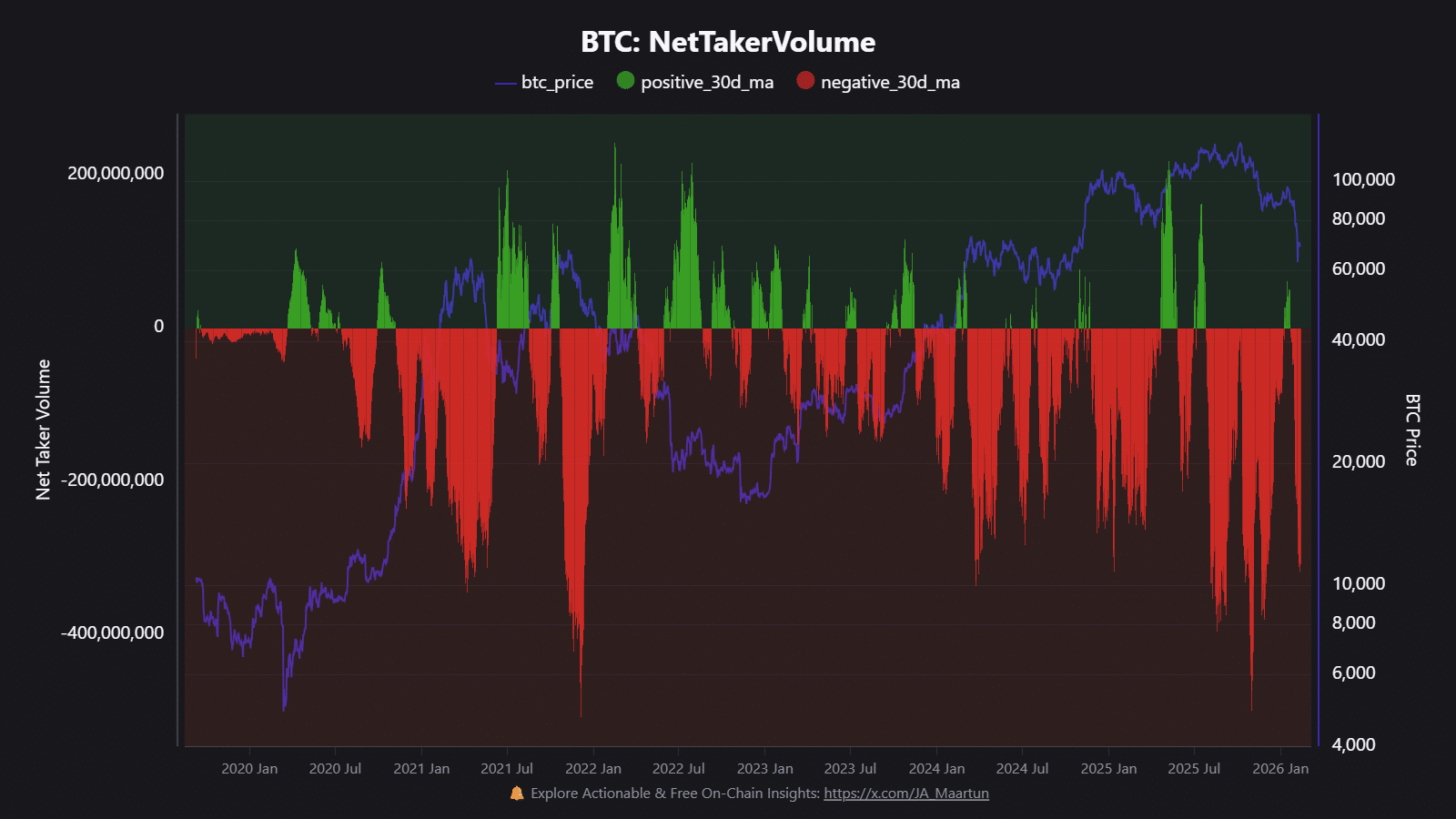
While exchange inflows revealed where whales positioned supply, taker flow exposes how that supply was executed. Net Taker volume flipped deeply negative as inflows accelerated into late 2025.
This phenomenon confirmed that transfers translated into active market selling, not passive positioning. Selling then intensified as Bitcoin retraced from the $95,000 region, with sharp red spikes marking aggressive distribution.
Source: CryptoQuant
However, in earlier phases, similar inflow waves met steadier price reactions. This signaled strong bid absorption, likely enabled by ETF demand and deep exchange liquidity. As a result, the price maintained its structure despite the expanding supply.
As downside momentum extended into early 2026, absorption weakened. Larger negative prints aligned with sharper drawdowns, reflecting capitulation-style execution. Overall, the distribution shifted from passive flow to aggressive sell pressure led by large holders.
Liquidity drain and investor risk response
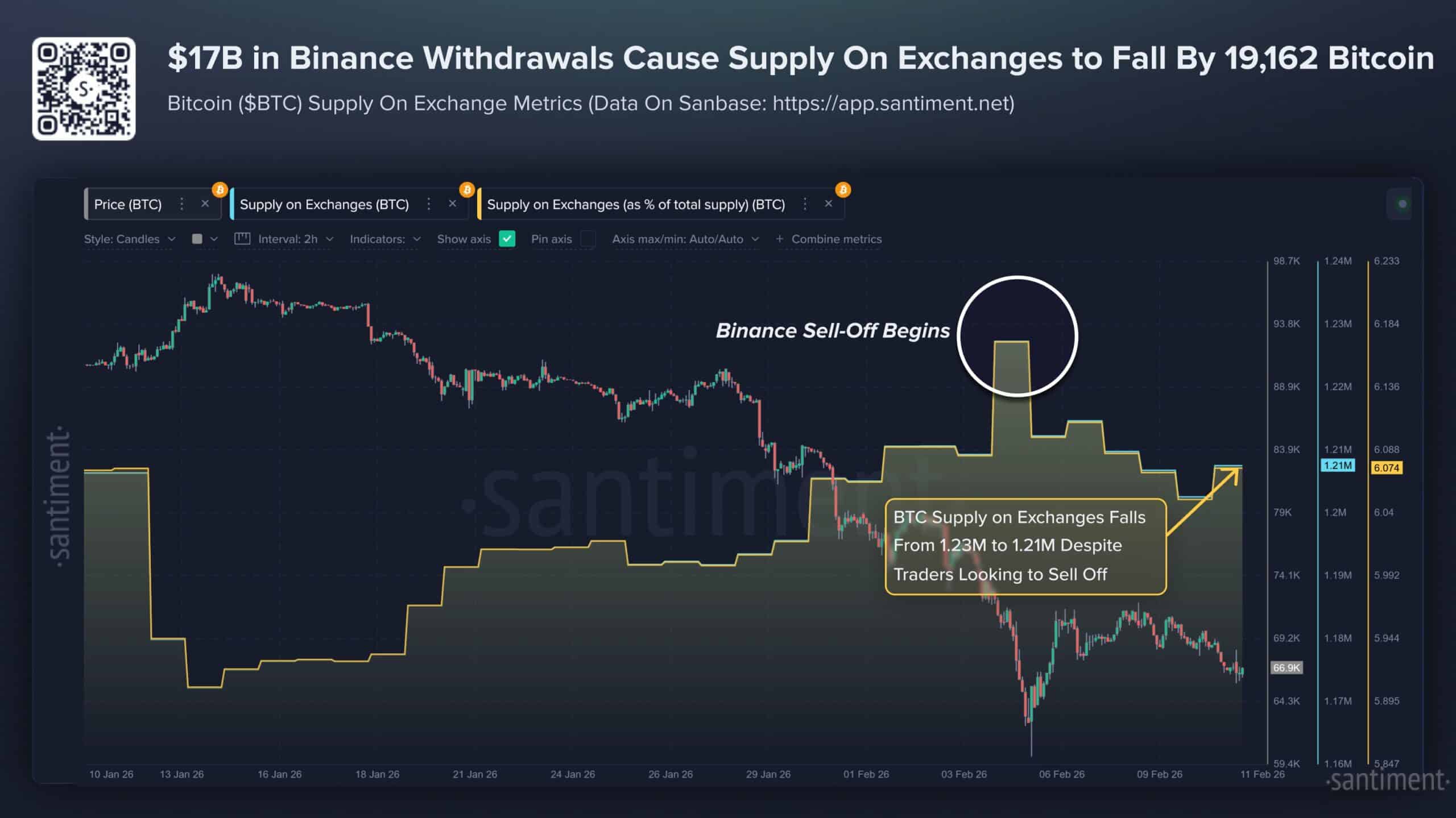
Exchange balances began falling as distrust toward Binance intensified after its perceived link to the 10th of October 2025, dump. Initially, withdrawals moved steadily as investors sought custody control.
Soon after, exits accelerated, producing a net outflow of 19,162 BTC. Binance alone processed nearly $17 billion in withdrawals, pushing exchange supply down from roughly 1.23 million BTC to 1.21 million BTC.
Source: Santiment
This scale of capital flight reflected risk aversion rather than profit-taking. Large holders shifted to cold storage, while some retail rotated to rival venues to access liquidity.
Consequently, the exchange sell-side inventory tightened. Price still weakened near term due to sentiment shock, yet reduced on-exchange supply cushioned deeper downside.
Overall, the $17 billion withdrawal signaled eroding trust, defensive capital rotation, and a market prioritizing custody security over active distribution.
Final Thoughts
-
Extreme whale inflow spikes translate into tangible sell pressure, yet institutional absorption and the $17 billion custody shift delayed immediate downside follow-through.
-
The transition from a 3,000 BTC inflow expansion to a 19,162 BTC reserve drawdown signaled distribution fatigue and a tightening sell-side overhang across exchanges.
Go to Source to See Full Article
Author: Muriuki Lazaro